The Day I Stopped Calling It ‘Behavior’

A Parent-Scientist’s Journey into Sensory Processing
I can still smell it if I try: antiseptic, warmed plastic, that oddly sweet hospital air that clings to your clothes after midnight. The waiting room is always the same: fluorescent lights, vending-machine hum, the little beep-beep-beep that makes your chest tighten even when it’s not your kid on the monitor.
If you’re reading this as a parent, here’s the honest version: I didn’t learn “sensory processing” from a textbook first. I learned it by watching my wife of 31 years (Suzy Girard at https://tenderwildfires.substack.com/) and my daughter move through a world that’s too loud, too bright, too fast, too unforgiving.
And I learned it the hard way: in ambulance rides, in triage bays, in those endless fluorescent hours where you’re trying to look calm for your kid while your own nervous system is screaming.
Our daughter Phoebe is 23 now. She’s autistic, ADHD, and she has epilepsy. And those words don’t capture the full story. The full story is 23 years of recalculating: new diagnoses, new meds, new plans. Some seasons were steady. Some were chaos. More than once, the ER became a second address (Parliamentary Office of Science and Technology, 2023).
We did what parents do when we’re scared and trying to be responsible: we researched, we documented, we advocated. Tricolon, but it’s also just survival.
Phoebe has had two craniotomies. I won’t dress that up. Two times signing forms with shaking hands. Two times watching doors swing shut. Two times learning that you can understand the brain and still feel helpless when it’s your kid on the other side of the glass (Ruttenberg, 2025b).
And that’s the parent-first truth underneath this whole post: when people see “behavior,” I see a nervous system doing its best under pressure.
And we did the ER. Again, again, again. Not once. Not twice. The kind of repetition that trains your nervous system to flinch at fluorescent lights and overhead announcements (Parliamentary Office of Science and Technology, 2023).
Somewhere between the first surgery and the second, I stopped calling what she was experiencing “behavior.”
Not because behavior isn’t real, but because it wasn’t the whole truth. It was the visible part, not the vital part. It was the smoke, not the fire. That’s the antithesis I couldn’t unsee: we were policing what we could observe while missing what she was enduring.
That shift changed everything.
The Language We Inherit
For years, I did what most parents do. I used the vocabulary I’d been given. Our daughter was “acting out.” She was “being difficult.” She “wouldn’t listen.” The professionals around us reinforced this framing. Behavior charts. Reward systems. Consequences.
None of it worked. Not because Phoebe wasn’t trying: she was trying harder than anyone in the room. It failed because we were treating the smoke while ignoring the fire.
In my doctoral research at UCL, Towards technologically enhanced mitigation of autistic adults’ sensory sensitivity experiences and attentional, and mental wellbeing disturbances (Ruttenberg, 2025b), I explored how technology can either amplify suffering or alleviate it. Same sensors, different outcomes. Same data, different dignity. That’s another antithesis that matters: tools can be assistive or abrasive, calming or cruel, human-centered or human-costly.
And in my earlier SensorAble work, we explicitly asked autistic participants and stakeholders what “helpful” even means in the context of adaptive wearables, because a tool that ignores lived experience isn’t innovative, it’s invasive (Ruttenberg et al., 2020).
What I learned as a scientist, I had already lived as a dad. I kept re-living it, too: in therapy waiting rooms, in school meetings, in emergency departments where the word “noncompliant” can show up in notes like it’s a diagnosis.

The Fire Behind the Smoke
Here’s what the behavioral paradigm gets wrong: it assumes the child is making a choice. A deliberate, conscious decision to be defiant, disruptive, or difficult.
But what if the nervous system is making decisions before conscious thought even enters the picture?
Research on sensory modulation demonstrates that individuals process sensory input along a continuum, with some nervous systems registering stimuli far more intensely: or far less intensely: than others (Miller et al., 2007). When a child’s sensory threshold is crossed, their response isn’t willful. It’s physiological. It’s survival.
The day I truly understood this, I stopped asking “Why is she doing this?” and started asking “What is she experiencing?”
That question opened a door I didn’t know existed.
Three Types of Sensory Sensitivity (They’re Not the Same)
One of the most common mistakes I see: in parenting books, in schools, even in clinical settings: is conflating different sensory profiles. So let me be clear: hyper-sensitivity, hypo-sensitivity, and sensory seeking are three distinct experiences.
Hyper-Sensitive (Over-Responsive)
A hyper-sensitive child’s nervous system treats ordinary stimuli as threats. The hum of a refrigerator is a roar. A clothing tag is a knife. A crowded cafeteria is a war zone. These children aren’t dramatic: their alarm systems are genuinely firing (Ben-Sasson et al., 2009).
For Phoebe, certain sounds could trigger a cascade: fight-or-flight, panic, shutdown. It looked like “behavior.” It was biology.
Hypo-Sensitive (Under-Responsive)
A hypo-sensitive child may seem checked out, sluggish, or unaware. They might not notice when their name is called. They may have a high pain tolerance or seem indifferent to temperature changes. Their nervous system requires more input to register that something is happening at all (Dunn, 2007).
This isn’t laziness. It’s a threshold issue. The signal isn’t getting through.
The Under-Sensitive Child (Sensory Seekers)
Some kids actively crave intense input. They’re the kids who spin, crash, chew, climb: not to misbehave, but because their bodies are hungry for stimulation. Their nervous systems need more, not less, and they’ll find ways to get it (Miller et al., 2007).
This is often confused with hypo-sensitivity, but the distinction matters. A hypo-sensitive child may passively miss input. A sensory seeker actively pursues it. Same underlying neurology, different expression.
Understanding which profile: or combination of profiles: your child experiences is the first step toward support that actually helps.

From Management to Regulation
Once I stopped calling it “behavior,” I started seeing Phoebe differently. Not as a problem to be solved, but as a person navigating a world that wasn’t built for her nervous system.
This shift: from behavioral management to sensory regulation: is backed by decades of occupational therapy research. Dunn’s (2007) Sensory Processing Framework demonstrates that when we match our responses to a child’s sensory needs, we see improvements in attention, emotional regulation, and daily functioning. We’re not “giving in.” We’re providing the conditions for success.
For our family, this meant:
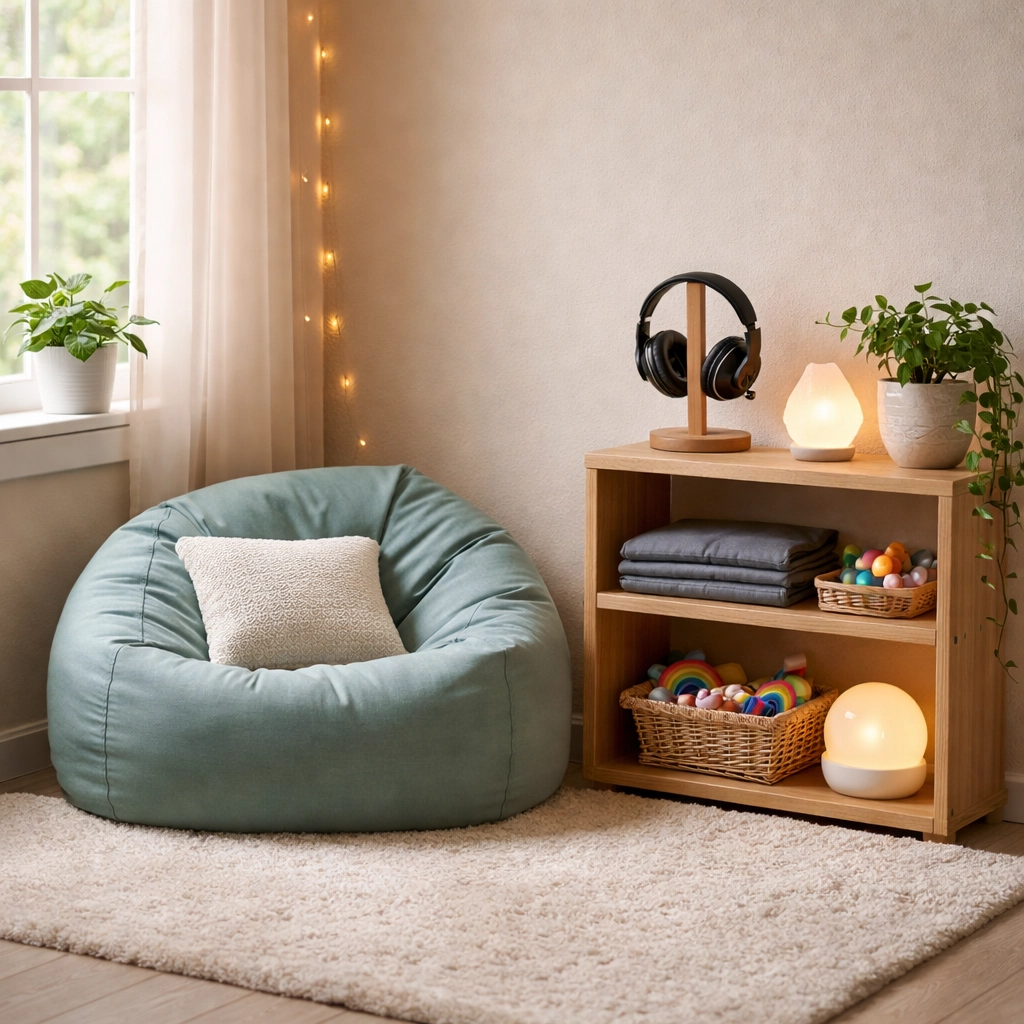
Environmental modifications: Reducing fluorescent lighting, offering noise-canceling headphones, creating quiet retreat spaces.
Sensory diet: Intentional activities that provided the input Phoebe’s system needed: movement breaks, deep pressure, fidget tools.
Co-regulation: Meeting her where she was, not where I wished she would be.
The UK Parliamentary Office of Science and Technology’s POSTnote 689 on invisible disabilities (Parliamentary Office of Science and Technology, 2023) highlights how often invisible needs go unrecognized because they don’t look like disability. They look like attitude. They look like defiance. They look like “behavior.” And that misrecognition has consequences: educational, social, medical.
This is where language quietly becomes policy. When we label a nervous system as a nuisance, we justify managing the child instead of supporting the child. When we mis-name the experience, we mis-treat the person. That’s polyptoton in real life: name, mis-name; treat, mis-treat.
And if you work in schools, healthcare, or government, this is the practical question: are we designing systems that keep people safe, or systems that keep people small? (Local Government Association, 2023; Parliamentary Office of Science and Technology, 2023)
What I Wish I’d Known Earlier
If I could go back and tell my younger self one thing, it would be this: the body keeps the score before the brain even knows the test is happening.
Phoebe wasn’t choosing to struggle. Her nervous system was doing exactly what it was designed to do: protect her from perceived threats. Our job wasn’t to extinguish that response. It was to understand it, honor it, and create conditions where she could thrive.
Suzy writes about this beautifully in her own work at Tender Wildfires: the intersection of parenting, neurodivergence, and the kind of love that keeps showing up, even when you’re exhausted, even when you’re scared, even when you know the next ambulance ride might be the one that rewires your family forever.
And yes, that fear is real. ER trauma is real. For Phoebe, emergency rooms weren’t just stressful: they were sensory mines. Bright lights, alarms, strangers touching her, rapid-fire questions, the pressure to “stay calm” in a room that is built to overwhelm (Parliamentary Office of Science and Technology, 2023). For us, it was the awful math of risk: seizures, meds, side effects, sleep deprivation. You start living in antithesis: hope and dread, relief and relapse, progress and backslide.
Practical Takeaways for Parents
If any of this resonates, here’s where to start:
Observe before you intervene. What happened right before the “behavior”? What sensory input was present: or missing?
Learn your child’s sensory profile. Are they hyper-sensitive, hypo-sensitive, sensory seeking: or some combination? A pediatric occupational therapist can help with formal assessment.
Reframe your language. “Meltdown” becomes “nervous system overload.” “Won’t” becomes “can’t right now.” Language shapes perception, and perception shapes response.
If you’re in the thick of it right now, please hear me: you’re not failing. You’re learning a new language: the language of your child’s nervous system. And that language can be learned.
The Question That Changed Everything
The day I stopped calling it “behavior” was the day I started seeing our daughter. Not her symptoms. Not her struggles. Her.
That reframe didn’t make the hard days disappear. It didn’t prevent the second craniotomy or erase the fear of the third. But it gave us a shared language: a way of understanding what was happening that didn’t require blame, shame, or punishment.
If you’re a parent in the waiting room right now: literal or metaphorical: I want you to know: the answer isn’t always trying harder. Sometimes it’s seeing differently.
If this post hit home, do one small thing today: write down one moment you used to label as “behavior,” and re-label it as “experience.” Then share this post with someone on your child’s team (teacher, therapist, family member) and ask them to do the same.
What shifted your understanding of your child’s experience? I’d love to hear your story. Drop a comment, share this with a parent or educator who needs it, or reach out directly through davidruttenberg.com.
“Dr David Ruttenberg PhD, FRSA, FIoHE, AFHEA, HSRF is a neuroscientist, autism advocate, Fulbright Specialist Awardee, and Senior Research Fellow dedicated to advancing ethical artificial intelligence, neurodiversity accommodation, and transparent science communication. With a background spanning music production to cutting-edge wearable technology, Dr Ruttenberg combines science and compassion to empower individuals and communities to thrive. Inspired daily by their brilliant autistic daughter and family, Dr Ruttenberg strives to break barriers and foster a more inclusive, understanding world.”
References
Ben-Sasson, A., Carter, A. S., & Briggs-Gowan, M. J. (2009). Sensory over-responsivity in elementary school: Prevalence and social-emotional correlates. Journal of Abnormal Child Psychology, 37(5), 705-716. https://doi.org/10.1007/s10802-008-9295-8
Dunn, W. (2007). Supporting children to participate successfully in everyday life by using sensory processing knowledge. Infants & Young Children, 20(2), 84-101. https://doi.org/10.1097/01.IYC.0000264477.05076.5c
Local Government Association. (2023). Safeguarding roles and responsibilities: Safeguarding is everybody’s business. https://www.local.gov.uk/publications/safeguarding-roles-and-responsibilities-safeguarding-everybodys-business
Miller, L. J., Anzalone, M. E., Lane, S. J., Cermak, S. A., & Osten, E. T. (2007). Concept evolution in sensory integration: A proposed nosology for diagnosis. American Journal of Occupational Therapy, 61(2), 135-140. https://doi.org/10.5014/ajot.61.2.135
Parliamentary Office of Science and Technology. (2023). Invisible disabilities in education and employment (POSTnote 689). UK Parliament. https://post.parliament.uk/research-briefings/post-pn-0689/
Ruttenberg, D. (2025b). Towards technologically enhanced mitigation of autistic adults’ sensory sensitivity experiences and attentional, and mental wellbeing disturbances (Doctoral thesis, University College London). https://discovery.ucl.ac.uk/id/eprint/10210135/
Ruttenberg, D., Holmes, J., & colleagues. (2020). PhD pilot project #2: PPI questionnaire on adaptive wearable appropriateness as an autistic intervention [Unpublished manuscript]. University College London. https://discovery.ucl.ac.uk/id/eprint/10097073


Comments