The Sensory Office: Designing AI Environments That Don't Burn Out Your Team

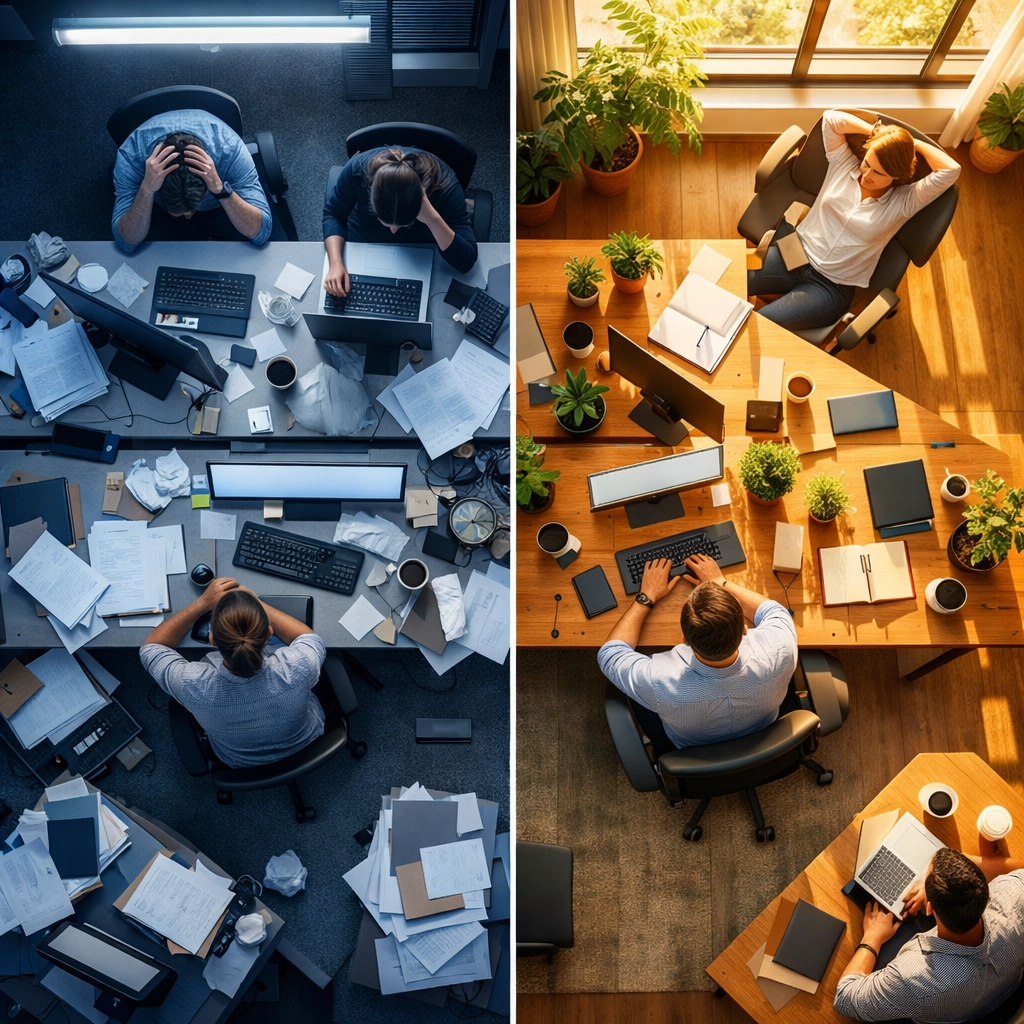
Your office is burning people out: and you might not even know it.
The fluorescent lights hum at 60 Hz. The air conditioning blasts cold air while the sun heats the window seats to 80 degrees. Open-plan acoustics mean every keyboard click, phone call, and coffee machine grind competes for attention. And everyone's expected to perform at their peak in this sensory chaos.
One-size-fits-all office design doesn't fit anyone. It's time to stop treating your team like interchangeable parts and start recognizing what neuroscience has known for years: sensory environments directly impact cognitive function, stress levels, and burnout rates (Clements-Croome, 2018).
The Problem with Generic Office Design
Traditional offices operate on an industrial-era assumption: if the temperature is between 68-72°F and the lights are on, everyone should be fine. But human nervous systems don't work that way.
Research shows that 72% of employees believe future workplaces should automatically adjust to individual needs (Leesman, 2022). They're not asking for luxury: they're asking for basic sensory accommodation. The open-plan office that helps one person collaborate might be creating a sensory nightmare for another person trying to focus.
I've seen this firsthand. As a parent of a brilliant autistic daughter navigating sensory sensitivities daily, I've watched how environmental factors that seem "neutral" to neurotypical people can be overwhelming or underwhelming for others. The same principles apply in your workplace.
Enter AI-Powered Environmental Adaptation
Artificial intelligence isn't just for chatbots and data analysis. It's transforming how offices respond to individual sensory needs in real time.
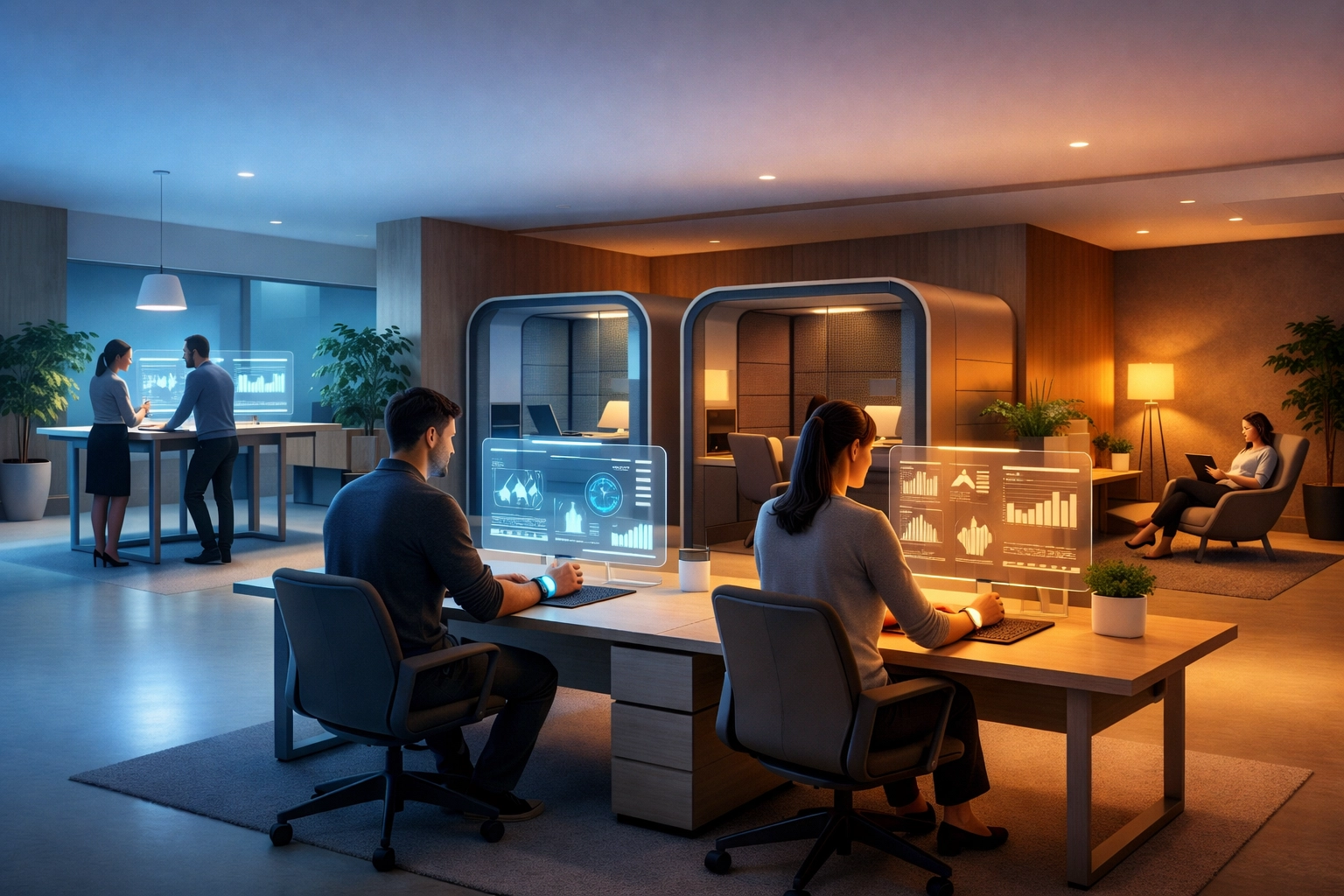
MIT Media Lab's Mediated Atmosphere project demonstrates this brilliantly. Their smart office uses biosignal sensors and machine learning to personalize the sensory experience (Alavi et al., 2016). The system tracks heart-rate variability and facial expressions to monitor focus and stress, then automatically adjusts lighting, sound, projection, and thermal control.
Here's what makes it work: employees don't need to become environmental engineers. They simply indicate whether they want to focus or de-stress, and the AI handles the technical adjustments. No manual fiddling with thermostats. No debates over window blinds. The technology adapts to human needs, not the other way around.
Emerging AI systems can monitor noise levels, temperature, and lighting, automatically adjusting conditions to suit individual preferences (Deloitte Insights, 2023). Imagine an office where the environment learns your patterns: dimming lights when you're in deep work mode, adjusting acoustics during video calls, and warming your workspace during afternoon focus sessions.
Spatial Design: Creating Sensory Zones
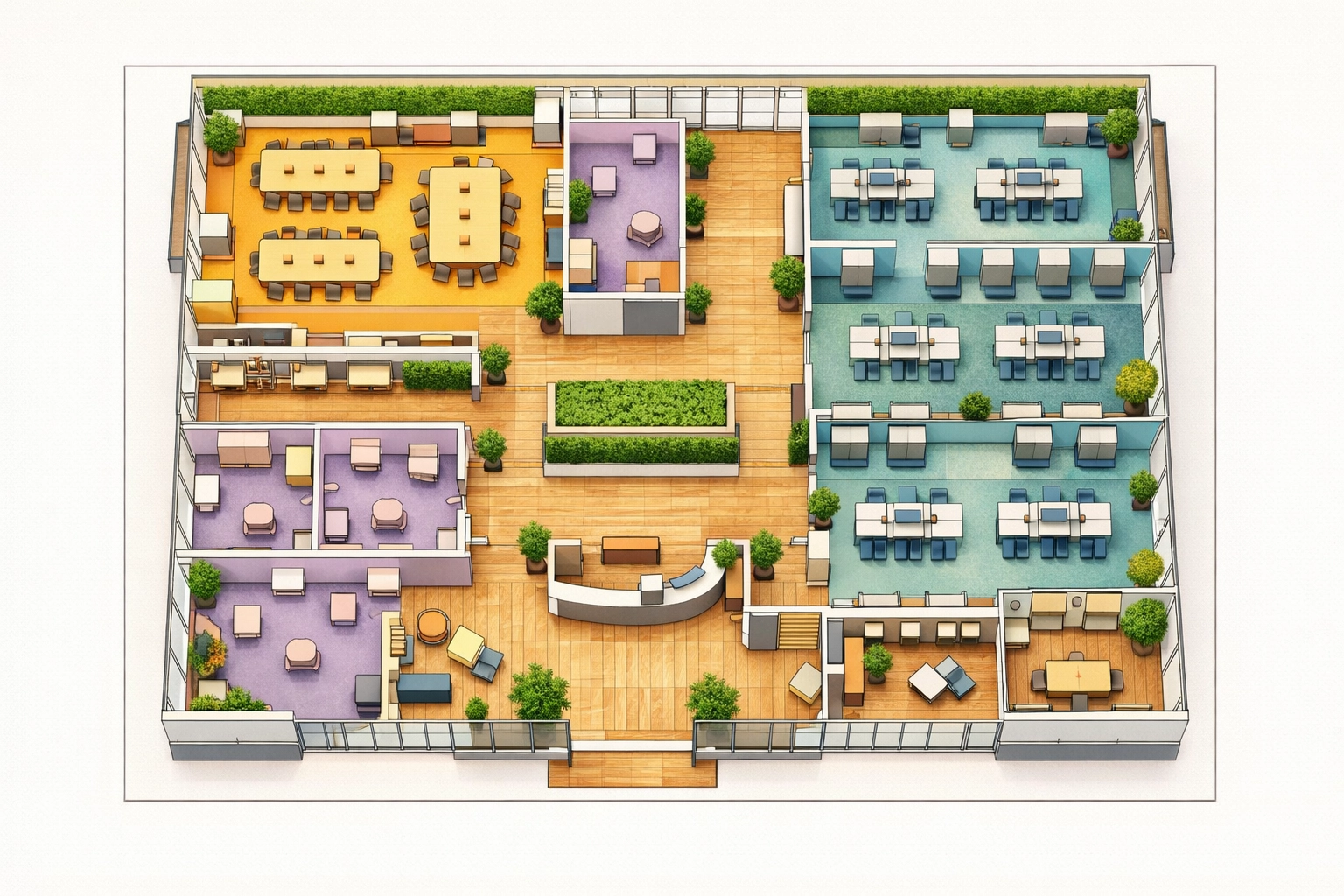
Technology alone won't solve the problem. You need intentional spatial planning with high-stimulation and low-stimulation zones.
Think of your office as a sensory landscape, not a uniform grid. Different tasks require different environments. Collaborative brainstorming thrives in energized, well-lit spaces. Deep analytical work needs quiet, controlled sensory input. Quick recovery from overwhelm demands calm, minimal-stimulus retreats (Ruttenberg, 2025).
Key design elements include:
Sensory rooms and quiet spaces: These aren't "break rooms": they're professional tools for cognitive recovery. When someone's sensory system is overloaded, a 10-minute reset in a calm environment can restore hours of productivity (Davis et al., 2021).
Open sight lines for navigation: Anxiety spikes when people can't easily orient themselves. Clear visual pathways reduce wayfinding stress and help everyone: especially those with spatial processing differences: move confidently through the space.
Color-coded signage and visual aids: Large text, high contrast, and intuitive symbols make navigation accessible. This isn't just for people with vision differences; it reduces cognitive load for everyone.
Single-person reflection rooms: Private spaces for quick sensory recovery or stress management. These rooms acknowledge that humans aren't machines: we need moments to regulate our nervous systems.
Tech-free zones: Screen-optional rooms give employees choice. Sometimes the best way to solve a problem is to step away from the digital barrage.
Flexible Furniture: Beyond the Standing Desk
Adaptable furniture isn't a trend: it's a necessity. Free-standing meeting tables, adjustable desks, and modular pods enable workers to configure spaces for their specific tasks (MillerKnoll, 2022).
But here's the key: flexibility means choice, not chaos. Provide the options, then let people experiment. Some team members will thrive standing at adjustable desks. Others need stable, grounded seating. Some work best in enclosed pods; others prefer open collaboration tables.
The goal isn't to force everyone into the same "optimal" setup. It's to acknowledge that optimal is personal.
Addressing Individual Senses
A truly sensory-friendly office tackles each sense strategically:
Lighting: Natural light is essential for circadian rhythm regulation and mood (Clements-Croome, 2018). But intensity matters. Varied lighting levels accommodate hypersensitive employees who find bright lights painful and hyposensitive employees who need stronger visual input to stay alert.
Sound: Soundproofing in open workplaces increases efficiency and decreases stress. Consider acoustic panels, white noise systems, and zoned audio control. Give people the option to work in silence or with ambient sound.
Materials and texture: Warm-toned natural materials like wood generate biophilic effects: our nervous systems respond positively to natural elements. Diverse textures support tactile processing and ergonomic comfort.
Scent and air quality: Subtle, consistent scents can create calming brand experiences, but be cautious: strong fragrances can trigger sensory overload or allergic reactions. Focus on air quality first.
Temperature: Thermal regulation is hugely individual. Provide localized climate control where possible, or create zones with different temperature ranges.
Implementation: Start Small, Scale Smart
You don't need to rebuild your entire office tomorrow. Start with pilot projects:
Audit your current environment: Map sensory stimuli across your workspace. Where are the loud zones? The bright spots? The temperature fluctuations?
Survey your team: Ask what sensory factors help or hinder their work. You'll get surprising answers.
Create one quiet zone and one collaboration zone: Test the concept before full implementation.
Implement basic AI controls: Start with smart lighting and temperature systems that learn user preferences.
Measure outcomes: Track productivity, sick days, and employee satisfaction. The data will justify scaling.
Organizations using comprehensive neuroinclusive design frameworks report measurable improvements across more than 50 key performance indicators (Gensler, 2023). The investment pays off in reduced burnout, increased retention, and better cognitive performance.
The Bottom Line
Designing AI-powered sensory offices isn't about creating luxury spaces. It's about recognizing a fundamental truth: your team's nervous systems are diverse, and performance suffers when environments ignore that diversity.
The technology exists. The research is clear. The only question is whether you'll act before your best people burn out.
Ready to transform your workplace into a human-centered environment that actually supports human brains? Let's talk about what sensory-smart AI integration could mean for your organization.
About the Author
Dr David Ruttenberg PhD, FRSA, FIoHE, AFHEA, HSRF is a neuroscientist, autism advocate, Fulbright Specialist Awardee, and Senior Research Fellow dedicated to advancing ethical artificial intelligence, neurodiversity accommodation, and transparent science communication. With a background spanning music production to cutting-edge wearable technology, Dr Ruttenberg combines science and compassion to empower individuals and communities to thrive. Inspired daily by their brilliant autistic daughter and family, Dr Ruttenberg strives to break barriers and foster a more inclusive, understanding world.
References
Alavi, H. S., Lalanne, D., Nembrini, J., Churchill, E., Kirk, D., & Moncur, W. (2016). Future of human-building interaction. Proceedings of the 2016 CHI Conference Extended Abstracts on Human Factors in Computing Systems, 3408-3414. https://doi.org/10.1145/2851581.2856502
Clements-Croome, D. (2018). Effects of the built environment on health and well-being. In Creating the Productive Workplace (3rd ed., pp. 3-35). Routledge.
Davis, T. N., Dacus, S., Bankhead, J., Haupert, M., & Fuentes, L. (2021). A comparison of self-monitoring with and without a sensory room on classroom behavior. Journal of Autism and Developmental Disorders, 51(1), 267-273. https://doi.org/10.1007/s10803-020-04532-2
Deloitte Insights. (2023). The future of the workplace: Technology-enabled employee experience. Deloitte Development LLC.
Gensler. (2023). Workplace surveys: Designing for neurodiversity. Gensler Research Institute.
Leesman. (2022). The future workplace: Employee expectations in a post-pandemic world. Leesman Index.
MillerKnoll. (2022). Adaptable workplace design: Research insights. MillerKnoll Research Division.
Ruttenberg, D. (2025). Mitigating autistic adults' sensory sensitivity through multi-sensory assistive wearable technology [Doctoral dissertation, University College London]. UCL Discovery. https://discovery.ucl.ac.uk/id/eprint/10210135/


Comments