Human-Centered AI vs Traditional AI: Which Is Better For Your Organization?

Here’s a question that keeps executives up at night: Why do most AI projects fail? It’s not because the technology doesn’t work. It’s because the people don’t use it. But here’s my ‘why’ behind human-centered AI: it’s not just a business decision. For me, it’s a personal mission. I am a parent first. Our daughter Phoebe is 23. She’s autistic, has ADHD, and lives with epilepsy. She’s also brilliant. And the difference between ‘traditional’ and ‘human-centered’ tech isn’t academic in our house. It’s the difference between tech that isolates and tech that empowers someone like our daughter, who has faced ER visits, two craniotomies, and years of therapy. That’s why this matters. Not because AI is trendy, but because it’s everywhere: in education, healthcare, workplaces, government services. And when we design it wrong, we don’t just lose adoption. We lose access. The difference between AI that transforms your organization and AI that collects dust comes down to one fundamental choice: Do you start with the technology, or do you start with the humans? Traditional AI builds the model first and searches for problems second. Human-centered AI does the opposite: it identifies real human needs first and designs the technology around them (Shneiderman, 2020). One approach treats people as an afterthought. The other treats them as the entire point. So which is better for your organization? Let’s break it down.
The Traditional AI Trap
Traditional AI is seductive. It promises efficiency, automation, and competitive advantage. And technically, it delivers. The algorithms work. The accuracy scores impress. The demos dazzle.
Then reality hits.
Your team avoids the new system. Workflows get disrupted. Trust erodes. And that expensive AI investment becomes an expensive lesson in human nature.
But zoom out from the boardroom for a second and think like a caregiver. If a system is confusing, rigid, noisy, unpredictable, it doesn’t just get “low adoption.” It becomes one more barrier a person has to climb around. For neurodivergent people (and for many disabled people), that barrier can be the difference between participating and being sidelined (Parliamentary Office of Science and Technology, 2023).
According to research, most AI pilots fail not because of technical limitations, but because they overlook human factors entirely (Xu, 2019). People avoid using AI systems when they feel confusing, interrupt established workflows, create fear about job security, or lack transparency about how decisions are made.
Traditional AI asks: “What can this technology do?”Human-centered AI asks: “What do our people need?”
That’s the contrast that determines success or failure.
What Human-Centered AI Actually Looks Like
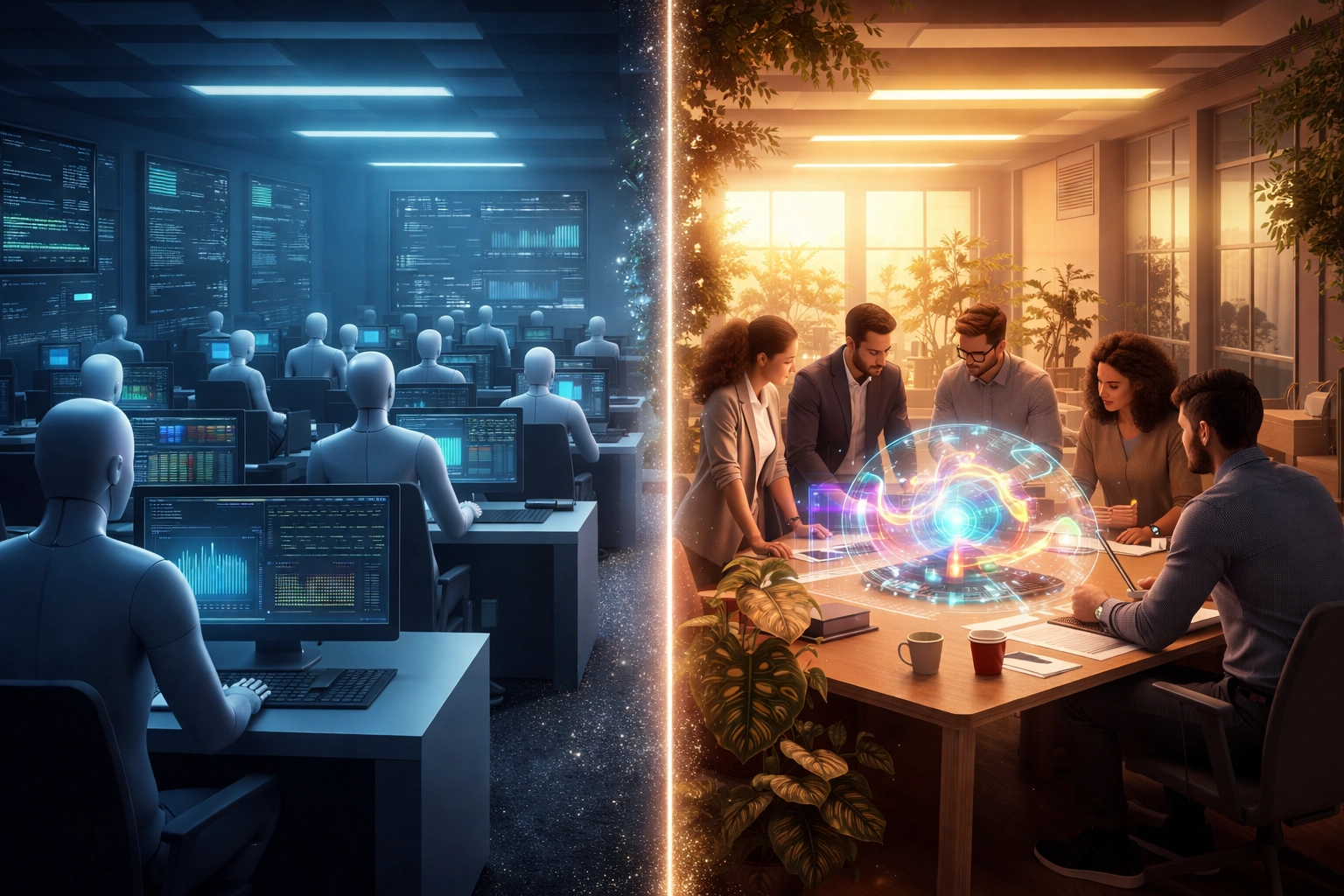
Human-centered AI isn’t just a buzzword or a marketing spin. It’s a fundamentally different philosophy, and for families like mine it’s also a standard we can’t afford to ignore. Where traditional AI operates independently of human input, human-centered AI keeps people in the loop. Where traditional AI prioritizes algorithmic performance, human-centered AI prioritizes trust, usability, and real-world adoption (Riedl, 2019). In plain terms: it’s the difference between a tool that judges people and a tool that helps people. Here’s what that looks like in practice:
Transparency over black boxes. Users can see how decisions are made, not just what decisions are made.
Collaboration over replacement. The AI supports human judgment rather than overriding it.
Adaptation over disruption. The technology fits existing workflows instead of forcing people to change everything.
And here’s the ‘why’ behind those bullets: people like Phoebe don’t need more friction, more gatekeeping, more “figure it out.” They need tech that reduces cognitive load, respects sensory realities, and supports independence. Clear, calm, consistent. Helpful, not hostile. My own research on assistive wearable technology has reinforced this principle repeatedly. When developing multi-sensory systems for neurodivergent users, the technology only succeeds when it’s designed around how people actually experience the world, not how engineers assume they should (Ruttenberg, 2025).
The Antimetabole That Changes Everything
Here’s the insight that separates organizations that thrive with AI from those that struggle:
Don’t fit people into your AI. Fit AI into your people.
And here’s the personal version I carry with me as a parent:
Don’t make Phoebe adapt to your system. Make your system adapt to Phoebe.
Read that again. It’s not wordplay for the sake of cleverness. It’s the operational philosophy that determines whether your AI investment pays off or becomes shelf-ware, and whether real people get included or quietly pushed out.
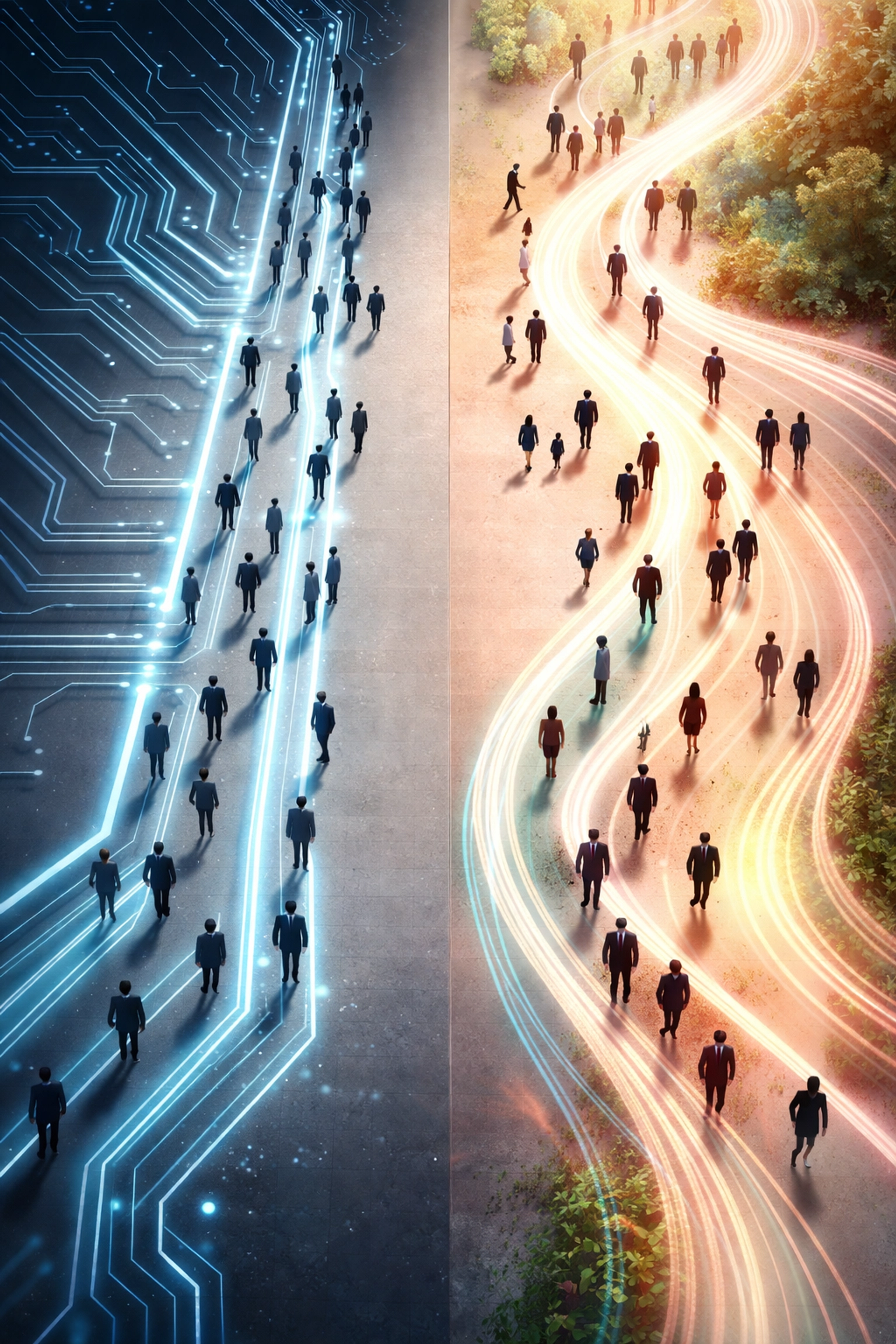
Traditional AI assumes that once you build something technically impressive, people will adapt. Human-centered AI assumes the opposite: that technology must adapt to people, or people will simply walk away.
This matters even more when your workforce includes neurodivergent employees or individuals with different sensory, cognitive, or attention profiles. Research on invisible disabilities shows that one-size-fits-all technology often excludes the very people it claims to serve (Parliamentary Office of Science and Technology, 2023).
The Business Case for Human-Centered AI
Let’s talk ROI. Because at the end of the day, this isn’t just about philosophy. It’s about results. But the real ‘why’ is bigger than revenue. Human-centered AI is what happens when you treat inclusion as a design requirement, not a diversity slogan. When you build for the margins, you build better for the middle. When you design for the most sensitive users, you reduce friction for everyone. That’s not charity, it’s craft. Organizations that adopt human-centered AI see:
Higher adoption rates. When users are involved early and systems are designed for trust, implementation actually sticks.
Reduced risk. Ethical and legal exposure drops when you design for fairness, transparency, and inclusivity from the start.
Better business outcomes. Human-defined success metrics outperform narrow technical benchmarks every time.
Stronger culture. Teams feel supported rather than surveilled, empowered rather than replaced.
This is where neuroscience consulting becomes invaluable. Understanding how human attention works, how cognitive load affects decision-making, and how sensory sensitivity impacts technology use transforms AI from a tool that fights human nature into one that works with it (Ruttenberg, 2020).
The Contrast in Action
Let me paint two pictures.
(Quick note: sensory profiles aren’t one-size-fits-all either. In my work I keep HYPER, HYPO (Under-sensitive), and SENSORY SEEKING distinct, including “The Under-Sensitive Child (Sensory Seekers)” as its own profile. Human-centered design starts by respecting those differences, not flattening them.)
Organization A invests heavily in a cutting-edge AI system. It’s technically flawless. The vendor promises 40% efficiency gains. Six months later, usage data shows that only 15% of employees interact with it regularly. The rest have found workarounds. The efficiency gains never materialize.
Organization B takes a different approach. Before writing a single line of code, they interview users. They map workflows. They identify pain points. They build trust through transparency. The resulting system is less flashy, but adoption hits 85% in the first quarter. Real efficiency gains follow.
One organization built AI for people. The other built AI with people.
The technology was similar. The outcomes were worlds apart.

Where Do You Start?
If you’re evaluating AI for your organization, or wondering why your current AI isn’t delivering, here are three questions to ask:
Who was in the room when this was designed? If the answer is “only engineers,” you have a problem.
Can users explain how the AI makes decisions? If not, trust will never develop (Shneiderman, 2020).
Does the AI adapt to workflows, or do workflows adapt to the AI? The answer reveals everything. If you want one extra, parent-tested question: If Phoebe had to use this on her hardest day, would it help her, or would it punish her? If the honest answer is “punish,” redesign it. Human-centered AI isn’t harder to build. It’s just built differently. And in a world where AI adoption is fundamentally a human problem, not a technical one, that difference is everything (Xu, 2019).
The Bottom Line
Traditional AI optimizes for machines. Human-centered AI optimizes for meaning. Traditional AI measures success in accuracy scores. Human-centered AI measures success in human outcomes. Traditional AI asks what technology can do. Human-centered AI asks what people actually need. That’s the business case. Here’s the human case: for families like mine, the stakes aren’t a dashboard. They’re dignity. Not convenience, capability. Not efficiency, access. Tech that isolates makes life smaller. Tech that empowers makes life bigger. The choice isn’t really about which approach is “better” in the abstract. It’s about what you’re actually trying to achieve. If you want impressive demos, traditional AI will deliver. If you want lasting transformation, human-centered AI is the only path forward. Ready to build AI that people actually trust and use?Connect with Dr. David Ruttenberg and let’s design human-centered systems that empower your teams and include the people most often left out (Riedl, 2019).
Dr David Ruttenberg PhD, FRSA, FIoHE, AFHEA, HSRF is a neuroscientist, autism advocate, Fulbright Specialist Awardee, and Senior Research Fellow dedicated to advancing ethical artificial intelligence, neurodiversity accommodation, and transparent science communication. With a background spanning music production to cutting-edge wearable technology, Dr Ruttenberg combines science and compassion to empower individuals and communities to thrive. Inspired daily by their brilliant autistic daughter and family, Dr Ruttenberg strives to break barriers and foster a more inclusive, understanding world.
References
Parliamentary Office of Science and Technology. (2023). Invisible disabilities (POSTnote 689). UK Parliament.
Riedl, M. O. (2019). Human-centered artificial intelligence and machine learning. Human Behavior and Emerging Technologies, 1(1), 33-36.
Ruttenberg, D. (2020). SensorAble: Sensory sensitivity, wearable technology, and machine learning approaches. University College London.
Ruttenberg, D. (2025). Towards technologically enhanced mitigation of autistic adults’ sensory sensitivity experiences and attentional, and mental wellbeing disturbances [Doctoral thesis, University College London]. https://discovery.ucl.ac.uk/id/eprint/10210135/
Shneiderman, B. (2020). Human-centered artificial intelligence: Reliable, safe & trustworthy. International Journal of Human-Computer Interaction, 36(6), 495-504.
Xu, W. (2019). Toward human-centered AI: A perspective from human-computer interaction. Interactions, 26(4), 42-46.


Comments