Sensory Sensitivity in Kids: A Parent's Guide to Understanding Attention and Focus
- David Ruttenberg
- 3 days ago
- 7 min read

Updated: 16 hours ago
I'm a doctor and a scientist, but I'm a parent first. If you're reading this because your kid can't filter a noisy room, can't tolerate a clothing tag, or can't hold onto a teacher's words when the world gets loud, I want you to know something up front: I've been on this road too, not as a researcher looking in, but as a dad living it.
My wife of 31 years (Suzy Girard at https://tenderwildfires.substack.com/) and I have been raising our daughter, Phoebe, for 23 years. She identifies as autistic and ADHD, and she also lives with epilepsy. Our family has walked the whole path: the first evaluations, the diagnosis appointments you replay in your head for weeks, the endless forms, the waitlists, the therapies you try because you love your child and you will try anything. Occupational therapy, behavioral supports, school meetings, sensory tools, medication discussions, specialist referrals, more specialist referrals.
And then there's the part people don't talk about enough. The ERs. The long hours. The helpless minutes watching seizures steal comfort, safety, sleep. Phoebe's epilepsy became drug-resistant, and she underwent TWO craniotomies to reduce that resistance to epilepsy medications. That reality changes you. It also sharpens what matters: compassion over judgment, support over shame, practical steps over perfect theories.
Sensory sensitivity is real, it's common, and it can absolutely hijack attention, learning, and day-to-day life (Child Mind Institute, 2023; Understood.org, 2024). The good news? When you understand what's happening inside your child's nervous system, you can make changes that actually help.
Let's break it down together.
What Is Sensory Sensitivity, Really?
When Phoebe was younger, I used to think "distracted" meant "not trying". I was wrong. Sensory sensitivity isn't about attitude, it's about input. It's the nervous system doing exactly what it's built to do: detect, prioritize, protect, even when it over-detects.
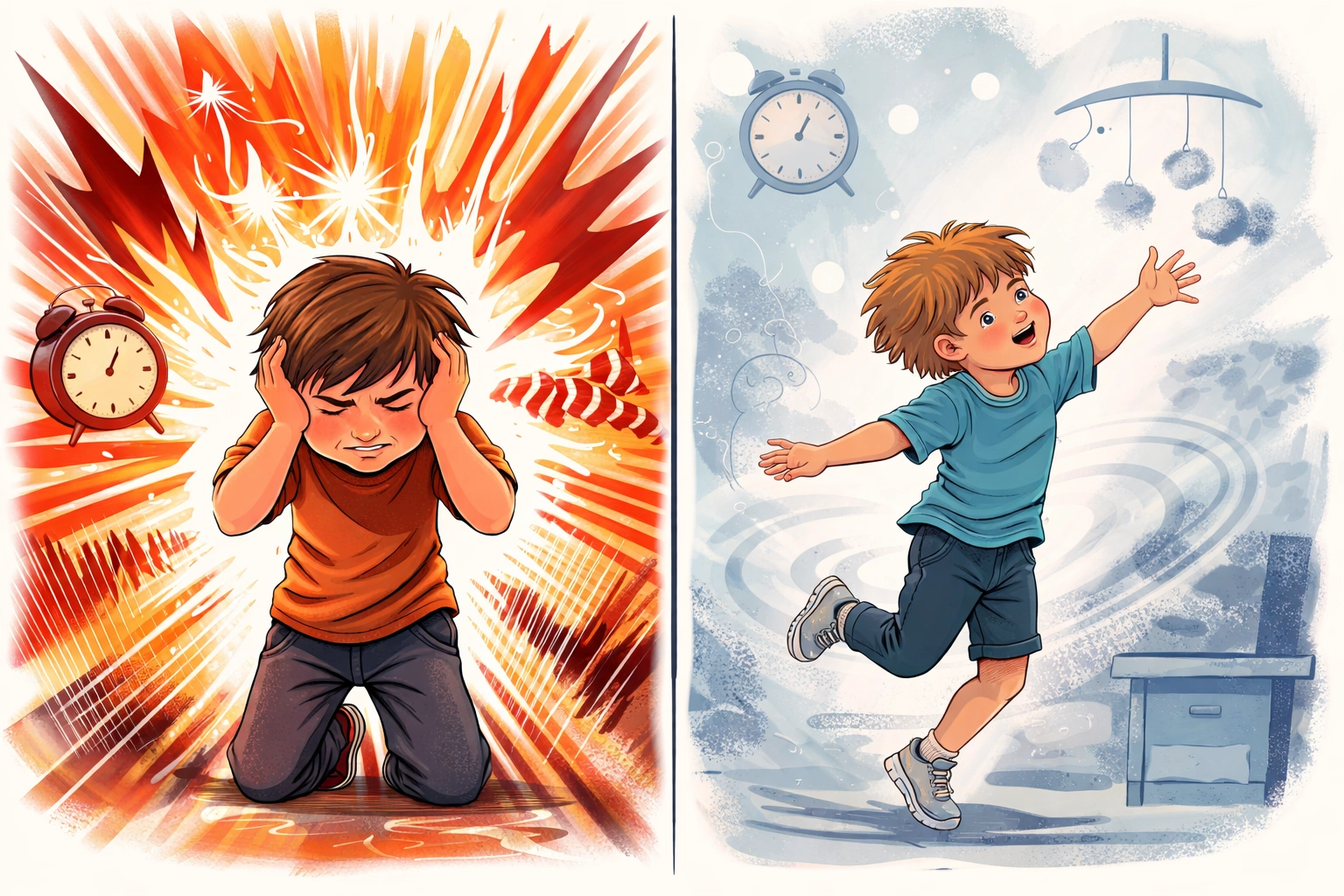
Here's the metaphor I keep coming back to: your child's brain is an air-traffic control tower. For many kids, planes come in one at a time. For sensory-sensitive kids, every plane arrives at once, alarms blare, radios crackle, lights flash, and the tower is still expected to land the lesson safely. In a classroom, that can mean fluorescent lights buzzing like a live wire, a pencil tap hitting like a jackhammer, a sock seam feeling like sand in a shoe you can't remove.
This isn't a behavioral problem. It's a neurological difference in how the brain processes sensory information (Child Mind Institute, 2023; STAR Institute, 2023).
Children with sensory sensitivity experience the world at a different volume. Some have the dial turned up too high, some have it turned too low, and either way, sustained attention gets expensive fast (Understood.org, 2024).

The Attention Connection: Why Focus Feels Impossible
I know what it's like to watch your child struggle and think, "If you could just focus, you'd be fine." But sensory sensitivity and attention are tied together like two gears: when one jams, the other can't turn.
If your child's nervous system is working overtime to manage sound, light, texture, movement, there is simply less left for math, reading, friendships, instructions (Understood.org, 2024). It's not laziness. It's load.
Picture trying to read a page while the room turns into a pinball machine: lights flashing, noises ricocheting, fabric scratching, thoughts bouncing. That's what focus can feel like when the sensory world is too big, too bright, too much. And when the body is in that state, headaches, tension, exhaustion can follow, which makes attention even harder (STAR Institute, 2023).
This is one of the biggest mindset shifts I had to learn as a parent: the goal isn't "make them behave", it's "help them regulate" (Child Mind Institute, 2023).
Three Common Sensory Profiles: Hyper-sensitive, Hypo-sensitive, and Sensory Seeking
Sensory sensitivity isn't one-size-fits-all. In real life, I see three patterns come up again and again. Naming the pattern doesn't label your child, it gives you a map.
1) Hyper-sensitive (Over-responsive)
These kids are like smoke detectors set to maximum sensitivity: they go off at the slightest trigger. Their nervous system flags ordinary input as "too much". You might notice:
Covering their ears at sounds others barely register
Refusing certain fabrics or complaining about tags and seams
Becoming irritable or overwhelmed in crowds
Struggling with transitions between activities
Difficulty falling or staying asleep
For these kids, the world can feel like a thunderstorm they're constantly trying to escape. Every sensation feels urgent, demanding, exhausting (Child Mind Institute, 2023; STAR Institute, 2023).
2) Hypo-sensitive (Under-responsive)
Hypo-sensitive doesn't mean "seeking". It means the nervous system is under-registering input. Your child may genuinely not notice sensory information that others do, which can look like "tuned out" or "unaware" when they're actually missing the signal. You might notice:
Not noticing mess on face/hands, or not reacting much to pain, temperature, or bumps
Seeming unaware of name being called or cues others pick up quickly
Low energy or slow-to-respond in busy environments
Difficulty noticing when their body needs a break (hunger, thirst, needing the bathroom)
This can still impact attention, because it's hard to focus on what you can't clearly register in the first place (Understood.org, 2024).
3) Sensory Seeking (Actively craving input)
Sensory seeking is distinct from hypo-sensitivity, even though they can overlap. Seeking is about actively craving certain sensations to feel organized, calm, or "online". You might notice:
Constant movement: fidgeting, jumping, spinning, crashing
Chewing on objects or craving crunchy/strong flavors
Touching everything, getting very close to others, pushing for big hugs or pressure
Seeking intense physical sensations (swinging, climbing, rough-and-tumble)
These kids aren't being defiant or "hyper" for fun. They're often trying to regulate their nervous system through sensation (STAR Institute, 2023).
Red Flags: When to Pay Closer Attention
Every child has sensory preferences. Some kids don't like loud noises; others are picky about textures. That's normal. But sensory sensitivity becomes a concern when it consistently interferes with daily life, learning, and social development.
Watch for these patterns:
Difficulty following instructions despite clearly understanding them
Severe behavioral reactions to specific sensory experiences
Frequent need for breaks or quiet spaces
Meltdowns that seem disproportionate to the situation
Avoidance of activities other children enjoy
Physical complaints (headaches, stomachaches) in stimulating environments
If your child is struggling across multiple settings: home, school, social situations: it may be time to consult a pediatric occupational therapist or developmental specialist (STAR Institute, 2023).
Practical Strategies That Actually Work
Understanding the problem is half the battle. Here's how to start making life easier for your sensory-sensitive child:
Create a Sensory-Safe Home Base
Every child needs a space where their nervous system can rest. This might be a quiet corner with soft lighting, noise-canceling headphones, weighted blankets, or fidget tools. Think of it as a charging station for their overwhelmed brain.
Prepare for Transitions
Sensory-sensitive children often struggle with sudden changes. Give plenty of warning before transitions, use visual schedules, and build in buffer time between activities. Predictability is their friend.
Advocate at School
Work with teachers to create accommodations: preferential seating away from doors and windows, permission to use noise-reducing headphones, movement breaks, or access to a quiet space when overwhelmed. This is where I put my scientist hat back on, because the research is clear that small environmental adjustments can produce outsized gains in comfort, attention, learning (Ruttenberg, 2025; UK Parliament POST, 2023).
If you want a simple script for your next meeting, try this tricolon: "Reduce the load, protect the focus, support the child." It's not about special treatment, it's about fair access.
Validate Their Experience
Perhaps the most powerful thing you can do? Believe your child. When they say the lights are too bright or the cafeteria is too loud, they're not being dramatic. They're describing their reality. Validation builds trust: and trust builds resilience.

The Bigger Picture: Sensory Sensitivity Is a Difference, Not a Deficit
Here's what I want you to take away from this: your sensory-sensitive child isn't broken. Their brain is wired differently, and that wiring comes with challenges: but also with gifts.
Many sensory-sensitive children are deeply empathetic, creative, and perceptive. They notice details others miss. They feel deeply. In the right environment, these traits become superpowers.
The goal isn't to "fix" your child's sensitivity. It's to help them understand it, work with it, and build a life that accommodates their unique neurology. That's what truly human-centered support looks like (Ruttenberg, 2025).
When to Seek Professional Help
If your child's sensory sensitivity is significantly impacting their daily life, relationships, or learning, don't wait. Early intervention makes a real difference.
A pediatric occupational therapist can conduct a comprehensive sensory assessment and develop targeted strategies. Depending on your child's needs, you might also explore:
Sensory integration therapy
Cognitive behavioral approaches
Environmental modifications at home and school
Collaboration with educators and pediatricians
You don't have to figure this out alone. And neither does your child.
Final Thoughts
Parenting a sensory-sensitive child can feel isolating. You watch other kids breeze through birthday parties while yours shuts down. You try to explain (again) why that shirt "hurts". You wonder if you're missing something everyone else seems to know.
I won't pretend a blog post fixes any of this. I've sat in more waiting rooms than I'd like to remember. I've watched Phoebe suffer through seizures. I've lived the fear, the fatigue, the "what if this is our forever". But I've also learned this: understanding sensory sensitivity changes the whole story. When you see behavior as communication, you stop fighting your child and start fighting the environment.
Call to action: pick one setting this week (morning routine, homework, dinner, school pickup) and run a simple experiment for 7 days: reduce one sensory stressor, add one regulation tool, track what changes. If you want help turning that into an accommodation plan, or if you'd like to talk about ethical, human-centered assistive tech, reach out via https://www.davidruttenberg.com.
Your child's brain isn't broken. It's working hard. And with the right support, the right environment, the right timing, they can thrive.
Dr David Ruttenberg PhD, FRSA, FIoHE, AFHEA, HSRF is a neuroscientist, autism advocate, Fulbright Specialist Awardee, and Senior Research Fellow dedicated to advancing ethical artificial intelligence, neurodiversity accommodation, and transparent science communication. With a background spanning music production to cutting-edge wearable technology, Dr Ruttenberg combines science and compassion to empower individuals and communities to thrive. Inspired daily by their brilliant autistic daughter and family, Dr Ruttenberg strives to break barriers and foster a more inclusive, understanding world.
References
Child Mind Institute. (2023). Sensory processing issues explained. https://childmind.org/article/sensory-processing-issues-explained/
Ruttenberg, D. (2025). Towards technologically enhanced mitigation of autistic adults' sensory sensitivity experiences and attentional, and mental wellbeing disturbances [Doctoral dissertation, University College London]. https://discovery.ucl.ac.uk/id/eprint/10210135/
STAR Institute. (2023). Understanding sensory processing disorder. https://sensoryhealth.org/basic/understanding-sensory-processing-disorder
UK Parliament Parliamentary Office of Science and Technology. (2023). POSTnote 689: Invisible disabilities. https://post.parliament.uk/research-briefings/post-pn-0689/
Understood.org. (2024). Sensory processing issues: What you need to know. https://www.understood.org/en/articles/sensory-processing-issues-what-you-need-to-know
Comments