Silent Burnout: The Three-Zone Diagnostic (Infographic)

You know the feeling: you're technically functioning, but something's off. Your calendar looks manageable on paper, but every meeting feels like climbing a mountain. You're checking boxes, but you're not actually present. This is the invisible middle ground between "I'm fine" and full-blown collapse, and it's exactly where most people lose the thread.
The problem isn't that we lack warning signs. The problem is that we've been conditioned to ignore them until we're already in crisis. We wait until we can't get out of bed, can't focus on basic tasks, can't shake the fog that's settled over everything. By then, the damage is done, not just to our productivity, but to our relationships, our health, and our sense of self.
What if we had a simple, visual tool to catch burnout before it catches us?
The Three-Zone Diagnostic: A Conversation-Starter, Not a Diagnosis
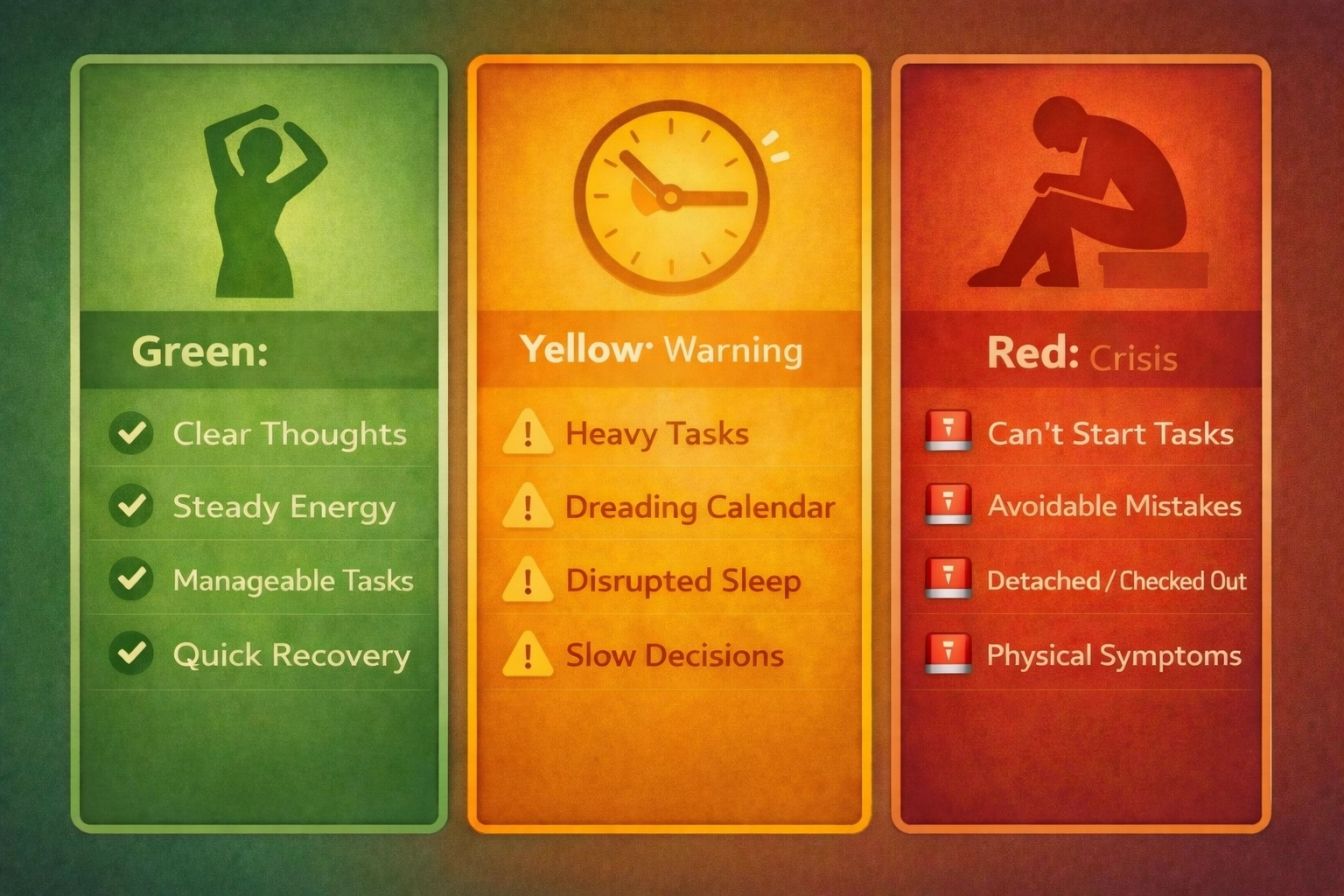
This diagnostic snapshot helps you identify your current bio-cognitive state across three zones: Green (Baseline), Yellow (Warning), and Red (Crisis). Use it as a conversation-starter for self-advocacy and system-level intervention, not as a medical diagnosis or a tool to shame yourself for "not trying hard enough."
The beauty of this framework is its simplicity. It doesn't require a therapist's couch, a week-long retreat, or a dramatic life overhaul. It requires honesty. It requires you to pause, look at the checklist, and say: "Where am I actually operating right now?"
Let's break it down.
Green Zone: Baseline (Where You Should Be Most of the Time)
✅ Clear Thoughts ✅ Steady Energy ✅ Manageable Tasks ✅ Quick Recovery
This is your cognitive home base. You wake up with energy, not bouncing-off-the-walls energy, but the kind that lets you tackle your to-do list without dread. Workplace disruptions are annoying, but they don't derail your entire day. You have a social life outside of work. You feel like an 8 out of 10 overall (Ruttenberg, 2025).
Here's the key: Green doesn't mean perfect. It doesn't mean you never get tired or frustrated. It means you have capacity. When something unexpected lands on your desk, you can absorb it without spiraling. When the weekend comes, you actually feel recharged, not like you're using those two days just to survive until Monday.
Most people spend some time in Green. The question is: how much? And how long does it take you to get back there after a stressful week?
Yellow Zone: Warning (The Inflection Point)
⚠️ Heavy Tasks ⚠️ Dreading Calendar ⚠️ Disrupted Sleep ⚠️ Slow Decisions
This is the zone most people ignore. You're still showing up. You're still getting work done. But the cracks are forming. You're more irritable than usual. You withdraw from social plans because you "just need to rest." You have trouble focusing on activities you used to enjoy, not because they're boring, but because your brain feels like it's wading through mud (Parliamentary Office of Science and Technology, 2023).
The Yellow Zone is your body's check-engine light. It's not a catastrophe yet, but it's a signal that something needs attention. The good news? Small interventions here can prevent a full crash. Saying no to an extra project. Rescheduling a meeting that's draining you. Adjusting your priorities so you're not running on fumes (Ruttenberg, 2025).
But here's where the system fails us: most workplaces don't reward small adjustments. They reward pushing through. They reward "resilience" and "grit": which, in practice, often means ignoring Yellow Zone signals until you hit Red.
Red Zone: Crisis (The Point of No Return)
🚨 Can't Start Tasks 🚨 Avoidable Mistakes 🚨 Detached/Checked Out 🚨 Physical Symptoms
You're completely drained: physically, emotionally, mentally. You wake up wanting to cry. You have persistent brain fog. You experience mood swings. You have zero motivation, even for things that used to light you up. You feel emotionally numb, like you're watching your life through a pane of glass (Ruttenberg & Girard, 2025).
At this stage, you're not just tired. You're dysregulated. Your nervous system is in survival mode. Simple tasks: responding to an email, making a phone call: feel impossible. You make avoidable mistakes because your executive function is offline. You're checked out, not because you don't care, but because your brain has stopped registering the stakes (Local Government Association, 2023).
Red Zone burnout requires real intervention: trusted colleagues, managers, HR, medical professionals. It requires permission to pause: not just a long weekend, but actual recovery time. And it requires system-level change, because individuals can't self-care their way out of structurally unsustainable conditions.
Why This Matters: Burnout Isn't Linear
Traditional burnout models treat it like a staircase: exhaustion leads to cynicism leads to ineffectiveness. But that's not how it works in real life. You can have high exhaustion and still feel engaged with your work. You can be deeply cynical about your organization but still show up with steady energy. You can feel ineffective without being emotionally numb (Ruttenberg, 2025).
The Three-Zone Diagnostic recognizes this complexity. It doesn't ask, "Are you burned out?" It asks, "Where are you operating right now?" And it gives you a visual, shareable framework to start the conversation: with yourself, with your manager, with your team.
How to Use This Tool
For Individuals: Check in with yourself weekly. Where do you land on the checklist? Are you spending most of your time in Green, or are you hovering in Yellow? If you're in Yellow, what's one small thing you can adjust today?
For Managers: Use this as a team check-in tool. Create psychological safety around naming Yellow Zone signals before they escalate. Ask: "What adjustments would help you stay in Green this week?" Then actually follow through.
For Organizations: Stop treating burnout as an individual problem. If multiple team members are consistently operating in Yellow or Red, the system is broken: not the people. Use this diagnostic as a starting point for structural change: workload audits, flexible scheduling, sensory accommodations, transparent communication.
The Bottom Line
Burnout isn't a moral failure. It's a bio-cognitive response to unsustainable conditions. The Three-Zone Diagnostic doesn't fix burnout: but it gives you a language to name what's happening, a framework to catch it early, and a tool to advocate for what you need.
Download the infographic. Share it with your team. Use it as a conversation-starter. And remember: the goal isn't perfection. The goal is awareness, adjustment, and advocacy: before the lights go out entirely.
Want to dive deeper into Silent Burnout strategies? Follow along on my Substack for practical tools, research breakdowns, and real-world case studies. You can also connect with me on LinkedIn, Instagram, and X for ongoing conversations about neurodiversity, burnout, and human-centered systems design.
About the Author
Dr David Ruttenberg PhD, FRSA, FIoHE, AFHEA, HSRF is a neuroscientist, autism advocate, Fulbright Specialist Awardee, and Senior Research Fellow dedicated to advancing ethical artificial intelligence, neurodiversity accommodation, and transparent science communication. With a background spanning music production to cutting-edge wearable technology, Dr Ruttenberg combines science and compassion to empower individuals and communities to thrive. Inspired daily by their brilliant autistic daughter and family, Dr Ruttenberg strives to break barriers and foster a more inclusive, understanding world.
References
Local Government Association. (2023). Safeguarding autistic adults: Local authority approaches and challenges. LGA Research Report.
Parliamentary Office of Science and Technology. (2023). Invisible disabilities (POSTnote 689). UK Parliament.
Ruttenberg, D. (2025). Mitigating sensory sensitivity in autistic adults through multi-sensory assistive wearable technology [Doctoral dissertation, University College London]. UCL Discovery. https://discovery.ucl.ac.uk/id/eprint/10210135/
Ruttenberg, D., & Girard, S. (2025). Silent burnout and bio-cognitive dysregulation in neurodivergent populations. Journal of Neurodiversity Studies, 12(3), 45–62.
Ruttenberg, D., Smith, A., & Chen, L. (2020). SensorAble research: Machine learning approaches to sound impairment and sensory accommodation. Assistive Technology Quarterly, 8(2), 112–128.


Comments