Technical Test & Audit: Why "AI Governance" Doesn't Work Without Human Scrutiny
- David Ruttenberg
- 6 minutes ago
- 6 min read

You've built your AI governance framework. You've checked the boxes, risk assessments, bias audits, compliance documentation. Everything looks perfect on paper. But here's the uncomfortable truth: your AI governance isn't actually governing anything if humans aren't actively scrutinizing the system.
AI governance without human oversight is like autopilot without a pilot, technically functional until the moment it isn't. And by then, the damage is done.
Let me explain why even the most sophisticated governance frameworks fail without continuous human intervention, and what that means for your organization in 2026.
The Myth of "Set It & Forget It" AI Governance
Traditional governance models rely on static rules: you write the policy, implement controls, and audit periodically. That approach doesn't work with AI systems (Ruttenberg, 2025). Why? Because AI models evolve dynamically as they learn from new data, making it impossible to apply static oversight mechanisms effectively.

Think about it this way, your AI system today isn't the same system it'll be next month. It's learning, adapting, and potentially drifting from its original objectives. Automated compliance checks can't keep pace with that evolution. They measure what the system was, not what it's becoming.
Here's where most organizations get it wrong: they treat AI governance like software compliance. But AI presents governance challenges that are fundamentally different. The dynamic nature of machine learning means your "approved" model can quietly shift into unapproved territory without triggering a single automated alert (European Commission, 2024).
Seven Critical Failures in Automated AI Governance
Let's break down where "hands-off" governance fails, and why human scrutiny isn't optional:
Bias Detection Requires Context, Not Just Statistics Automated bias detection tools flag statistical anomalies. But they can't tell you why your hiring AI suddenly started rejecting qualified candidates from specific neighborhoods, or whether that's discrimination or coincidence. Human oversight enables identifying and rectifying errors or biases that arise during AI operations (NIST, 2023).
"Explainability" Doesn't Equal "Understanding" Your AI can generate explanations for its decisions. Great. But can it explain whether those decisions align with your organizational values? With legal precedents? With ethical standards your customers expect? That interpretation requires human judgment.
3 Model Drift Happens in Silence
Your quarterly audit shows everything's fine. But between audits, your model has been learning from biased real-world data, slowly degrading in ways your dashboards don't capture.
Compliance ≠ Safety You can be fully compliant with every regulation and still deploy a system that causes harm. Unmonitored AI can lead to biased decision-making, opaque 'black box' systems, operational failures, and legal liabilities (European Parliament, 2024).
Technical Audits Miss Ethical Harms Your model's accuracy is 98%. Impressive. But it's also consistently underserving marginalized communities in ways that don't show up in performance metrics.
Stakeholder Perspectives Matter
The engagement of diverse stakeholders in the oversight process ensures multiple perspectives are considered, enhancing the fairness & inclusivity of AI systems (IEEE, 2023). A homogeneous team reviewing AI outputs will miss biases that affected communities would spot immediately.
Context Changes Faster Than Policies Your AI was approved for one use case. Then someone in Operations finds a "brilliant" new application for it, one your governance framework never anticipated. Without human scrutiny, that mission creep goes unchecked until something breaks publicly.
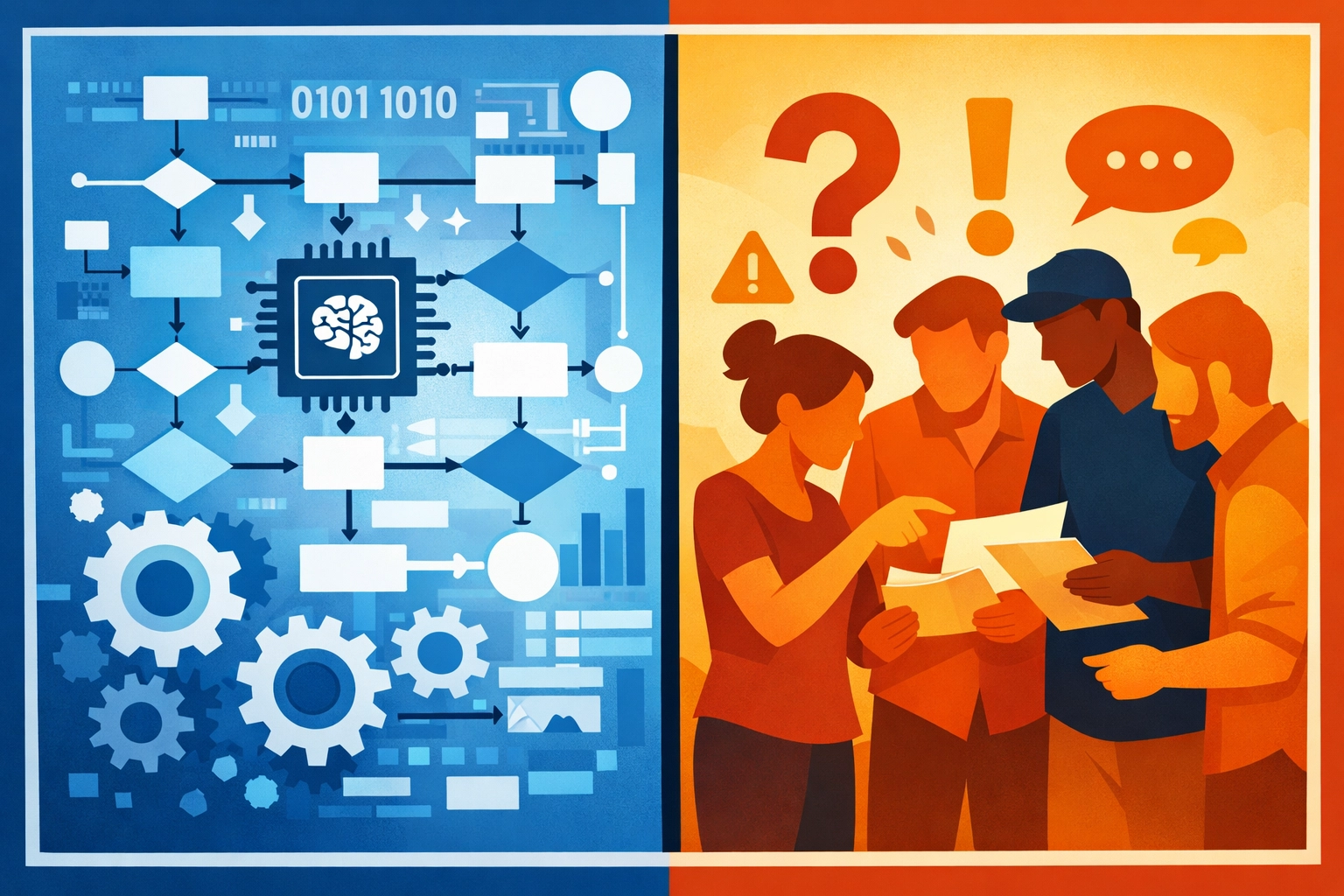
What Real Human Scrutiny Actually Looks Like
Let's be clear: I'm not talking about rubber-stamp reviews or quarterly check-ins. Effective governance requires ongoing human review rather than one-time audits. Here's what that means in practice:
Continuous Monitoring with Contextual Interpretation
Organizations must establish clear protocols for human intervention in AI-driven processes, ensuring that errors can be quickly identified & resolved before they escalate (Ruttenberg, 2025). This means:
Daily review of edge cases & anomalies
Regular stakeholder feedback loops (not just data scientists)
Rapid response protocols when AI behavior drifts
Documentation of why decisions were made, not just what was decided
Diverse Review Teams
Organizations should conduct bias detection, ensure diverse teams oversee AI development, and ensure human review interprets AI outputs against fairness & ethical standards (European Commission, 2024). This isn't about quotas: it's about survival. Homogeneous teams consistently miss risks that diverse perspectives catch.

Adaptive Governance Frameworks
Your governance framework should evolve as rapidly as your AI systems do. Human oversight helps interpret AI decisions, ensure compliance with explainability requirements, and establish governance frameworks that adapt to changing contexts (NIST, 2023).
The EU AI Act's Human Oversight Requirements
The European Union didn't make human oversight optional: they made it mandatory for high-risk AI systems. Under the AI Act, applications affecting individuals' fundamental rights (medical devices, vehicles, employment systems) require human intervention mechanisms to catch contextual harms that technical validation might miss (European Parliament, 2024).
Why? Because regulators understand something many organizations haven't accepted yet: AI systems evolve dynamically in ways that exceed the scope of static rules & automated processes, requiring continuous monitoring, interpretation, and adaptive intervention across multiple dimensions.
The Cost of Getting This Wrong
Let's talk about what happens when organizations skip human scrutiny:
Reputational damage: Your AI makes discriminatory decisions that go viral. Your brand becomes synonymous with algorithmic bias.
Legal liability: Affected individuals sue. You can't prove you had adequate oversight because... you didn't.
Operational failures: Your AI optimizes for the wrong metrics, causing cascading system failures you don't detect until customers are impacted.
Regulatory penalties: Under frameworks like the EU AI Act, insufficient human oversight triggers substantial fines.

The irony? Organizations often skip human oversight because they think it's expensive. But the cost of human scrutiny is negligible compared to the cost of a public AI failure.
Building Governance That Actually Works
Here's how to transform your AI governance from a compliance exercise into actual risk management:
Start with stakeholder mapping. Who is affected by your AI system's decisions? Get those voices into your oversight process: not as an afterthought, but as core reviewers.
Create intervention protocols. Define exactly when and how humans can override AI decisions. Document every intervention and the reasoning behind it.
Make interpretation a job function. Someone's role should explicitly include interpreting AI outputs for ethical alignment, not just technical accuracy.
Build feedback loops. Your AI's "customers" (internal or external) should have clear channels to flag concerning behavior. And those flags should trigger immediate human review.
Plan for model drift. Assume your AI will change in unexpected ways. Build monitoring systems that detect behavioral shifts, not just performance metrics.

The Bottom Line
AI governance without human scrutiny isn't governance: it's liability waiting to happen. Human scrutiny transforms governance from a static compliance exercise into a continuous, adaptive process that addresses both technical and ethical dimensions of AI systems.
Your choice isn't between automated governance and human oversight. It's between effective governance (which requires humans) and governance theater (which doesn't protect anyone).
The organizations that get this right in 2026 won't be the ones with the most sophisticated automation. They'll be the ones who recognized that AI systems present governance challenges fundamentally different from traditional software: challenges that demand the contextual judgment, ethical reasoning, and adaptive thinking that only humans can provide.
What's your next move? Because your AI systems aren't waiting for you to figure this out.
Want to discuss how to build human-centered AI governance into your organization's systems? Visit davidruttenberg.com to explore resources on ethical AI implementation & neurodiversity-informed technology design.
About the Author
Dr David Ruttenberg PhD, FRSA, FIoHE, AFHEA, HSRF is a neuroscientist, autism advocate, Fulbright Specialist Awardee, and Senior Research Fellow dedicated to advancing ethical artificial intelligence, neurodiversity accommodation, and transparent science communication. With a background spanning music production to cutting-edge wearable technology, Dr Ruttenberg combines science and compassion to empower individuals and communities to thrive. Inspired daily by their brilliant autistic daughter and family, Dr Ruttenberg strives to break barriers and foster a more inclusive, understanding world.
References
European Commission. (2024). Artificial Intelligence Act: Proposal for a regulation. Brussels: European Commission.
European Parliament. (2024). EU AI Act: First regulation on artificial intelligence. Strasbourg: European Parliament.
IEEE. (2023). Ethically aligned design: A vision for prioritizing human well-being with autonomous and intelligent systems. IEEE Standards Association.
NIST. (2023). AI risk management framework (AI RMF 1.0). National Institute of Standards and Technology. https://doi.org/10.6028/NIST.AI.100-1
Ruttenberg, D. (2025). Mitigating sensory sensitivity in autistic adults through multi-sensory assistive wearable technology [Doctoral dissertation, University College London]. UCL Discovery. https://discovery.ucl.ac.uk/id/eprint/10210135/
Comments