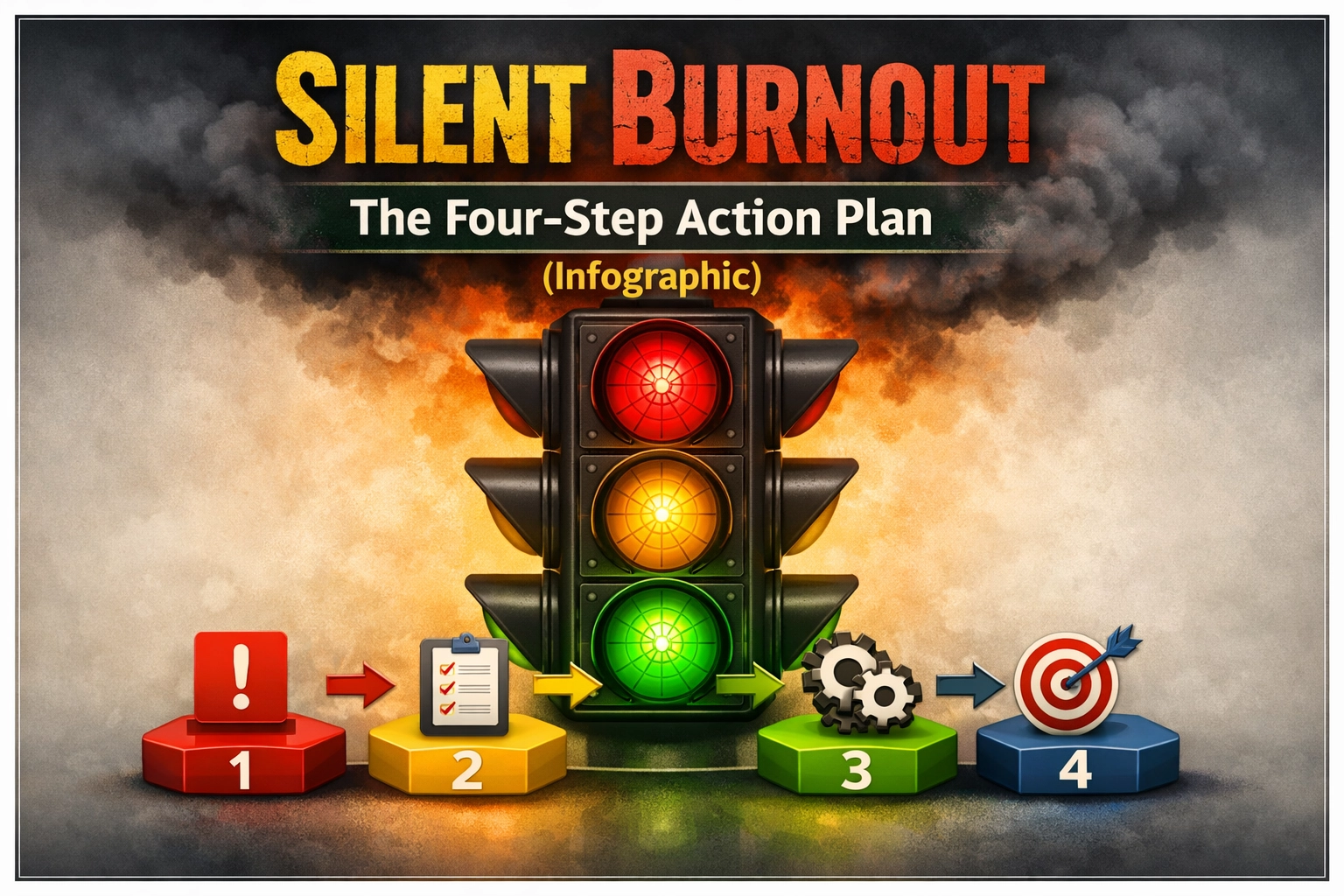
Silent Burnout: The Four-Step Action Plan (Infographic)
- David Ruttenberg
- Feb 11
- 5 min read

You recognize the warning signs. You've named what's happening inside your body and brain. Now what?
That's the gap where most burnout advice falls apart. Recognition without action is just awareness without armor. You need a roadmap: not a generic wellness checklist, but a structured intervention protocol that moves from acknowledgment to structural change (Maslach & Leiter, 2016).
This is that roadmap.
The Four-Step Action Plan: From Crisis to System-Level Change
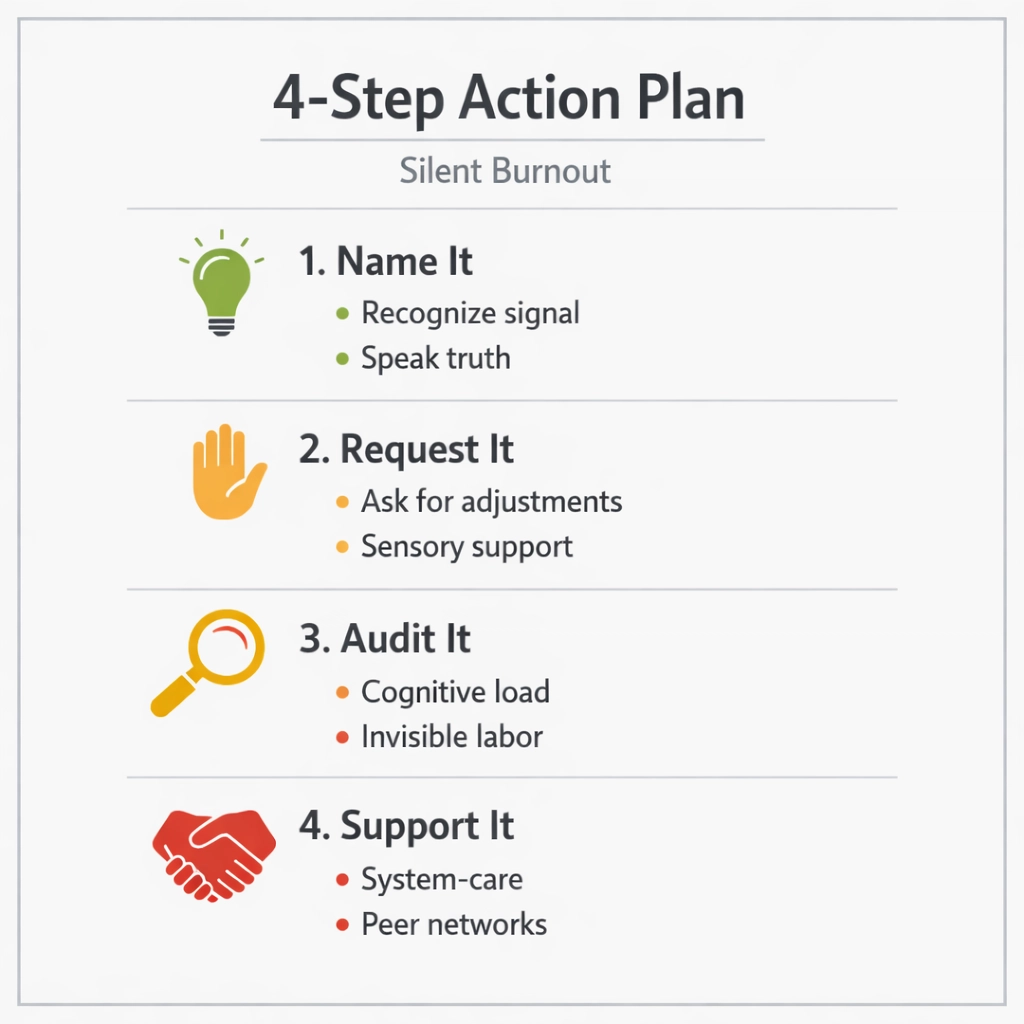
This four-step roadmap guides you from recognition to structural change: 1. Name It, 2. Request It, 3. Audit It, 4. Support It. Designed for individuals and organizations to build bio-cognitive safety into their daily operations.
Why four steps? Because silent burnout isn't a single-point failure: it's a systemic mismatch between human capacity and environmental demand (Ruttenberg, 2025). You can't fix it with one intervention. You need a phased approach that addresses immediate symptoms, structural causes, and long-term sustainability.
Let's break down each step.
Step 1: Name It: Speak the Signal Out Loud
Recognition is not the same as articulation. You can feel something is off without being able to say what's happening. The first step demands precision: name the zone you're in (Green, Yellow, Red), identify the bio-cognitive signals, and say it out loud to someone who can help (Ruttenberg, 2025).
Why speaking matters: Silent burnout thrives in silence. The moment you name it, you disrupt the internal narrative that says "everyone else is handling this fine." You externalize the problem. You make it visible. You create accountability: not just for yourself, but for the systems around you (Maslach et al., 2001).
Pro tip: Use the exact language from the Three-Zone Checklist. Don't soften it. Don't apologize. Say: "I'm in the Yellow Zone: I'm dreading my calendar and my sleep is disrupted." Precision removes ambiguity.
Step 2: Request It: Ask for Sensory and Cognitive Adjustments
Once you've named the signal, you need to request specific accommodations. Not vague "self-care" rituals: targeted adjustments to reduce cognitive load and sensory demand (Ruttenberg, 2025).
This is where bio-cognitive safety becomes operational. You might request: noise-canceling support during meetings, task simplification for the next 48 hours, or permission to decline non-essential obligations. You're not asking for permission to be human: you're engineering your environment to match your current capacity (Ruttenberg, 2023).
Key insight: Sensory support isn't luxury; it's infrastructure. If fluorescent lights are triggering hyperarousal, turning them off isn't "special treatment": it's basic Human Factors Safety (Bogdashina, 2016). Organizations that frame adjustments as equity rather than accommodation see better retention and performance outcomes (Ruttenberg, 2023).
Step 3: Audit It: Track Cognitive Load and Invisible Labor
Here's where most wellness frameworks collapse: they stop at individual symptom management and ignore the structural drivers. Step 3 demands a cognitive audit: a systematic review of what's actually consuming your attention, energy, and executive function (Ruttenberg, 2025).
Ask these questions:
What tasks am I performing that aren't in my job description?
How much emotional labor am I carrying for others?
Which meetings could be eliminated or shortened?
What decisions am I making that could be automated or delegated?
This isn't about productivity hacks. This is about revealing the invisible labor that drains bio-cognitive reserves without recognition or compensation (Maslach & Leiter, 2016). When you audit, you see patterns. When you see patterns, you can negotiate change.
Example: A neurodivergent professional realized they were spending 90 minutes daily "translating" ambiguous emails from leadership. That's not communication: that's uncompensated cognitive labor. Once audited, they proposed a standing protocol for structured briefs. Load reduced. Performance improved. Crisis averted (Ruttenberg, 2025).
Step 4: Support It: Build System-Care and Peer Networks
The final step is sustainability. You can't maintain bio-cognitive safety alone. You need system-level support and peer accountability (Ruttenberg, 2025).
System-care means embedding recovery practices into organizational design: mandatory recovery windows, no-meeting blocks, protected time for deep work, and explicit policies that prioritize human capacity over productivity theater (Maslach et al., 2001).
Peer networks mean building reciprocal support structures. Not therapy groups: operational alliances where people check each other's signals, share accommodation strategies, and hold leadership accountable when systems fail (Ruttenberg, 2023).
This is the shift from individual resilience to collective resilience. You stop asking "How do I survive this system?" and start asking "How do we redesign this system so everyone can thrive?"
Why This Works: Bio-Cognitive Safety as Default Operating Condition
Traditional burnout interventions treat symptoms while leaving structures untouched. The Four-Step Action Plan treats burnout as a systems failure: and systems failures require systems redesign (Ruttenberg, 2025).
When organizations implement this framework, they see:
Reduced attrition among high-performing neurodivergent staff
Faster identification of environmental mismatch before crisis
Improved psychological safety and team communication
Lower long-term healthcare and disability accommodation costs (Ruttenberg, 2023)
This isn't wellness theater. This is engineering human-centered operations.
Take the Next Step
If you're in the Yellow or Red Zone right now, don't wait. Name it. Say it out loud to someone who can help. Then use this roadmap to move from recognition to structural intervention.
For leaders and organizations: this infographic isn't a poster for your break room. It's a protocol. Embed it into onboarding, performance reviews, and team check-ins. Make bio-cognitive safety your default operating condition, not an afterthought.
Download the infographic. Share it with your team. Start the conversation today.
For more tools, research, and real-world case studies on building neurodivergent-friendly systems, subscribe to my Substack at https://substack.com/@drdavidruttenberg. Let's connect on LinkedIn, Instagram, and X (Twitter) to continue the discussion on bio-cognitive safety, ethical AI, and neurodiversity advocacy.
About the Author
Dr David Ruttenberg PhD, FRSA, FIoHE, AFHEA, HSRF is a neuroscientist, autism advocate, Fulbright Specialist Awardee, and Senior Research Fellow dedicated to advancing ethical artificial intelligence, neurodiversity accommodation, and transparent science communication. With a background spanning music production to cutting-edge wearable technology, Dr Ruttenberg combines science and compassion to empower individuals and communities to thrive. Inspired daily by their brilliant autistic daughter and family, Dr Ruttenberg strives to break barriers and foster a more inclusive, understanding world.
References
Bogdashina, O. (2016). Sensory perceptual issues in autism and Asperger syndrome: Different sensory experiences: different perceptual worlds (2nd ed.). Jessica Kingsley Publishers.
Maslach, C., & Leiter, M. P. (2016). Understanding the burnout experience: Recent research and its implications for psychiatry. World Psychiatry, 15(2), 103–111. https://doi.org/10.1002/wps.20311
Maslach, C., Schaufeli, W. B., & Leiter, M. P. (2001). Job burnout. Annual Review of Psychology, 52(1), 397–422. https://doi.org/10.1146/annurev.psych.52.1.397
Ruttenberg, D. (2023). Safeguarding autistic adults: A guide for local authorities. Local Government Association. https://www.local.gov.uk/publications/safeguarding-autistic-adults
Ruttenberg, D. (2025). Mitigating sensory sensitivity in autistic adults: A multi-sensory wearable technology approach [Doctoral thesis, University College London]. UCL Discovery. https://discovery.ucl.ac.uk/id/eprint/10210135/


Comments