Silent Burnout: The Visual Toolset (Checklists & Action Steps)

You don't need another wellness app. You don't need a meditation challenge or a “resilience workshop.” What you need is a mirror: something that reflects your bio-cognitive state in real time and tells you: green, yellow, or red.
This post delivers exactly that: two high-resolution infographics you can print, share, or bookmark. One shows you where you are. The other shows you what to do next.
No jargon. No medicalization. Just signal detection and structural intervention.
Why Infographics?
Because burnout is invisible until it isn't. This isn’t laziness. It isn’t a character flaw. It’s a bio-cognitive slowdown that shows up in predictable patterns: anxiety, fatigue, tunnel vision, missed details. (Ruttenberg, 2025). When you can see the pattern, you can intervene early: before the red zone becomes a crisis.
The Developmentally Aligned Design (DAD) Framework teaches us that recognition precedes accommodation (Ruttenberg, 2025). You can't fix what you can't name. These infographics give you the language and the scaffolding to start the conversation: with yourself, your manager, your team, or your family.
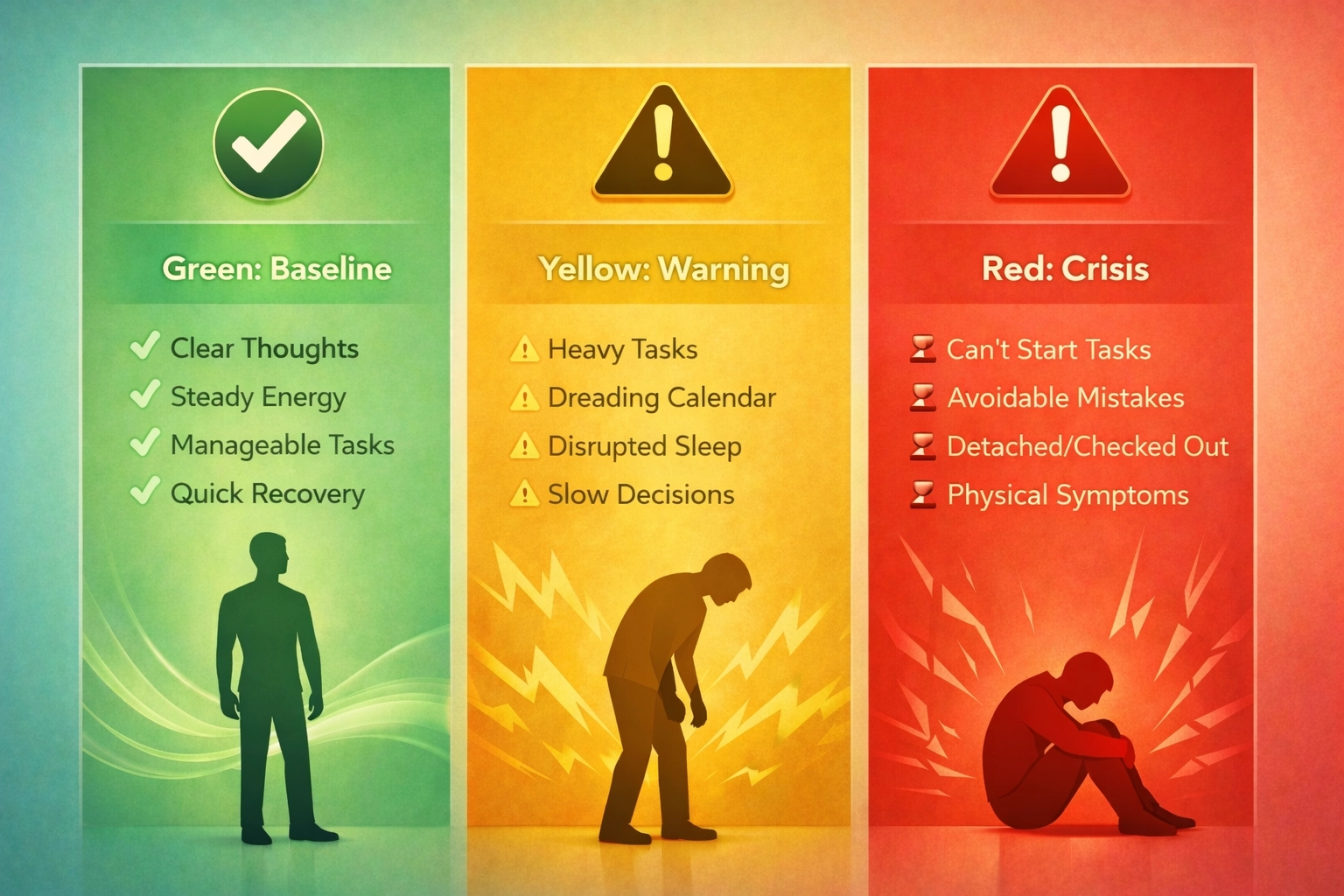
Infographic 1: The Three-Zone Checklist (Green, Yellow, Red)
This is your diagnostic snapshot. Three columns. Three zones. One question: Where am I right now?
🟢 Green Zone: Baseline Functioning
Clear thinking, easy decisions
Steady energy across the day
Details feel manageable
You recover quickly from stress
Social contact feels natural
If you’re checking most of these boxes most of the time, you’re in the green. Stay here.
🟡 Yellow Zone: Early Warning Signals
Minor tasks feel harder than usual
You’re scanning your calendar with dread
Small decisions take longer
You’re irritable or withdrawn
Sleep is disrupted but you’re still functional
Scoring (conversation-starter, not a diagnosis): Look back over the last 2 weeks. If you check 3+, treat it as a yellow flag: pause, talk, adjust the load. (Ruttenberg, 2025). This is where prevention lives. Most organizations ignore yellow: and pay for it later.
🔴 Red Zone: Structural Intervention Needed
You can’t start tasks, even urgent ones
You’re making avoidable mistakes
You feel detached or “checked out”
Physical symptoms appear (headaches, GI distress, chest tightness)
You avoid people or meetings entirely
Scoring (conversation-starter, not a diagnosis): If you check 2+, treat it as a red flag. This usually calls for structural intervention (work design, workload, support), not just “self-care.” (Maslach & Leiter, 2016). The red zone isn’t a personal failure. It’s a systems failure.
This checklist isn’t a diagnosis. It’s a conversation-starter. Print it. Share it. Use it in team check-ins or 1:1s. Make it part of your culture.

Infographic 2: The Four-Step Action Plan
Once you've identified your zone, you need a roadmap. This four-item infographic breaks down the intervention sequence: what we call the NRAS Protocol in applied Human Factors Safety practice (Ruttenberg, 2025).
1. Name It
Recognize the signal. Say it out loud. "I'm in the yellow zone" or "I've been in red for three weeks." Naming removes shame and opens the door to accommodation (Maslach, Schaufeli, & Leiter, 2001).
2. Request It
Ask for what you need. That might be deadline flexibility, workload redistribution, sensory accommodations, or temporary schedule adjustments. Most managers want to help: but they can't read your mind (Ruttenberg, 2023).
3. Audit It
Check your cognitive and sensory load. Are you working in an open-plan office with constant interruptions? Are you context-switching between 12 tools? Are you managing invisible labor that nobody's tracking? Write it down. Make it visible (Ruttenberg, 2025).
4. Support It
This is where culture meets structure. Build peer support networks. Advocate for policy change. Normalize accommodation. Push for transparency around workload metrics. Fix the system, support the person. (Ruttenberg, 2025).
This Is a Design Problem, Not a Resilience Problem
We don’t ask people to “build resilience” to toxic air: so why do we ask people to “build resilience” to toxic interfaces, impossible workloads, or sensory chaos? Silent Burnout is a Human Factors Safety issue. It’s about mismatched demand, inadequate recovery time, and systems that weren’t designed with bio-cognitive limits in mind (Ruttenberg, 2025).
The DAD Framework flips the script: instead of asking “Why can’t this person cope?” we ask “What is this environment demanding, and is that demand sustainable?” (Ruttenberg, 2025). That single question transforms burnout prevention from a personal responsibility game into an organizational design challenge.
How to Use These Tools
For Individuals:
Print the three-zone checklist. Score yourself weekly. Share your results with a trusted colleague, manager, or therapist. Use it as a prompt for self-advocacy.
For Managers:
Introduce the checklist in team meetings. Normalize talking about yellow flags. Make accommodation requests part of your regular workflow: not an emergency protocol (Ruttenberg, 2023).
For Organizations:
Embed these infographics in onboarding, performance reviews, and wellness programs. Train managers to recognize the signals. Build accommodations into work design, not just crisis response (Ruttenberg, 2025).
Next Steps
If you’re in the yellow or red zone, don’t wait. Name it. Request it. Audit it. Support it. If you’re a leader, make these tools part of your culture. If you’re a consultant or practitioner, use them as SME consulting deliverables in your client engagements.
Reach Out: Reach out by email or call my assistant Rachel at +1 (561) 979-0496 to start the conversation. Whether you need a keynote, a workshop, or a custom diagnostic toolkit for your organization, we’ll design the intervention to fit your context: not force your people into a one-size-fits-all model.
You can also connect directly at davidruttenberg@gmail.com or explore more resources at davidruttenberg.com.
Silent Burnout doesn’t have to stay silent. Let’s make the invisible visible: and turn recognition into action.
About the Author
Dr David Ruttenberg PhD, FRSA, FIoHE, AFHEA, HSRF is a neuroscientist, autism advocate, Fulbright Specialist Awardee, and Senior Research Fellow dedicated to advancing ethical artificial intelligence, neurodiversity accommodation, and transparent science communication. With a background spanning music production to cutting-edge wearable technology, Dr Ruttenberg combines science and compassion to empower individuals and communities to thrive. Inspired daily by their brilliant autistic daughter and family, Dr Ruttenberg strives to break barriers and foster a more inclusive, understanding world.
References
Maslach, C., & Leiter, M. P. (2016). Understanding the burnout experience: Recent research and its implications for psychiatry. World Psychiatry, 15(2), 103–111. https://doi.org/10.1002/wps.20311
Maslach, C., Schaufeli, W. B., & Leiter, M. P. (2001). Job burnout. Annual Review of Psychology, 52(1), 397–422. https://doi.org/10.1146/annurev.psych.52.1.397
Ruttenberg, D. (2023). Safeguarding autistic adults: Recognising risks and promoting wellbeing. Local Government Association. https://www.local.gov.uk/publications/safeguarding-autistic-adults
Ruttenberg, D. (2025). Mitigating sensory sensitivity in autistic adults through multi-sensory assistive wearable technology: A developmentally aligned design framework [Doctoral dissertation, University College London]. UCL Discovery. https://discovery.ucl.ac.uk/id/eprint/10210135/
UK Parliament POST. (2023). Invisible disabilities (POSTnote 689). https://post.parliament.uk/research-briefings/post-pn-0689/


Comments