Digital Fatigue and AI: Using Neuroscience to Build More Human-Centered Systems
- David Ruttenberg
- Feb 4
- 5 min read

I’m writing this as a parent first. Our daughter Phoebe is 23 and autistic, ADHD, and epileptic. We’ve done the rounds you never want to do: diagnoses, therapies, ER visits, and two craniotomies. When your kid’s brain is the battleground, you get very serious, very fast, about what helps attention, what steals it, and what quietly drains a person’s ability to cope.
We have all felt it. That heavy, foggy feeling after hours of video calls. The inability to concentrate after scrolling through endless notifications. The strange exhaustion that comes from doing nothing but staring at screens all day.
This is digital fatigue. And it is not just in your head. Well, actually, it is: but in a very real, neurological way.
As someone who has spent years researching sensory sensitivity and cognitive wellbeing, I have watched digital fatigue become one of the defining challenges of our time. The good news? Neuroscience offers us a roadmap to build AI systems that work with our brains, not against them.
What Is Digital Fatigue, Really?
Digital fatigue is more than just feeling tired after using technology. It is a state of cognitive and emotional exhaustion caused by prolonged interaction with digital devices and platforms. The symptoms include difficulty concentrating, increased irritability, headaches, and a general sense of being overwhelmed.
From a neuroscience perspective, digital fatigue stems from two primary mechanisms: cognitive overload and directed attention fatigue (Kaplan, 1995). Our brains are simply not designed to process the volume and velocity of information that modern technology throws at us.
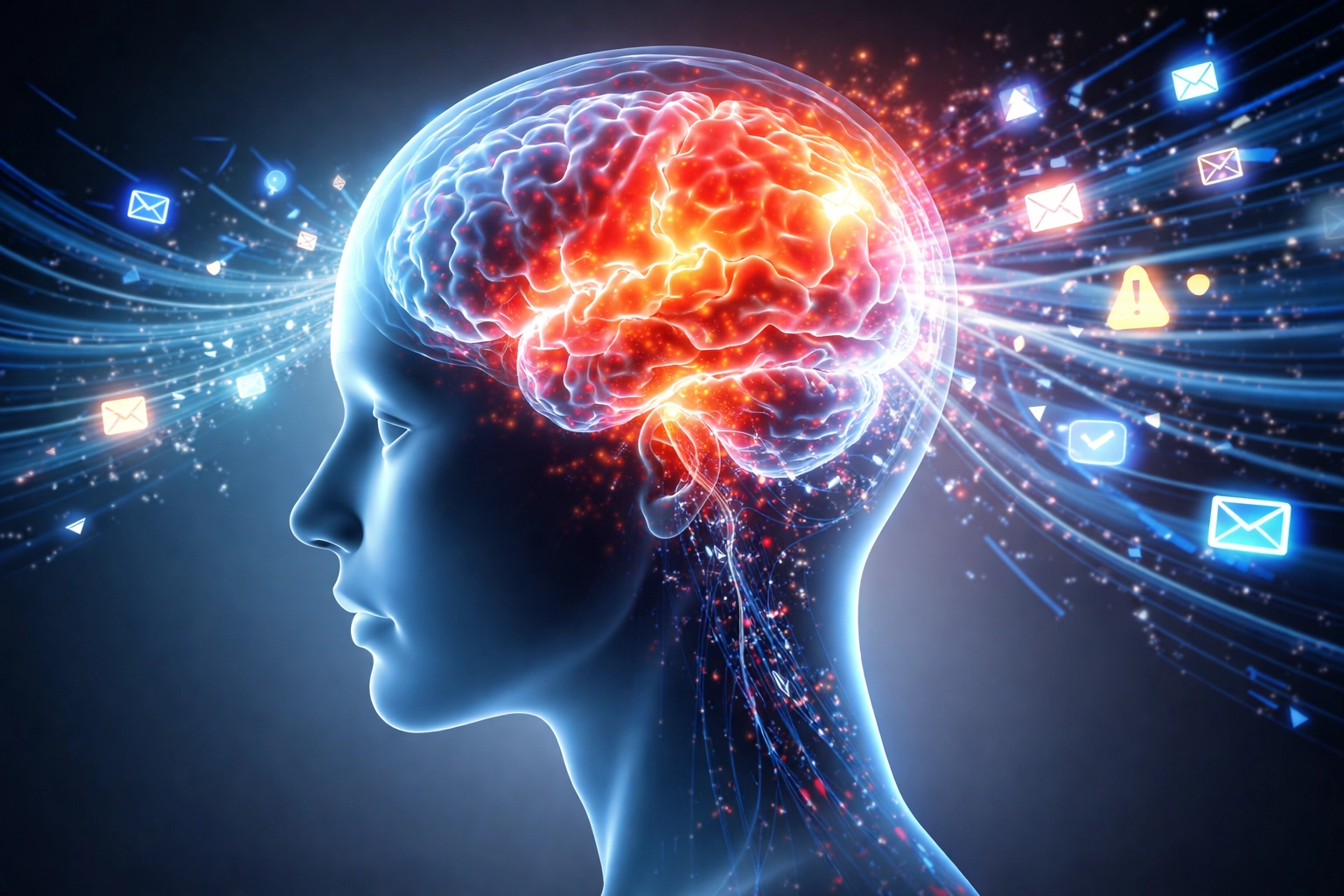
In my PhD research at University College London, I explored how sensory sensitivity experiences directly impact attentional and mental wellbeing disturbances (Ruttenberg, 2025a). What I found was striking: the same neurological pathways that become overwhelmed by sensory input are also taxed by digital environments. The brain does not distinguish between a loud, crowded room and a cluttered, notification-heavy screen. Both drain our cognitive reserves.
The Neuroscience Behind the Exhaustion
Your prefrontal cortex: the brain region responsible for decision-making, focus, and impulse control: takes the biggest hit from digital overload. Every notification, every tab, every decision to click or scroll requires this region to engage.
Research on Attention Restoration Theory tells us that directed attention is a finite resource (Kaplan, 1995). Unlike the “soft fascination” we experience in natural environments (think watching clouds drift by or listening to a stream), digital environments demand constant, effortful focus. There is no restoration built into the experience.
My earlier work on sound impairment and cognitive skill performance demonstrated how environmental stressors directly compromise our ability to think clearly (Ruttenberg et al., 2020). Digital platforms create a similar effect: they bombard us with stimuli while offering no cognitive respite.
Why Current AI Makes It Worse
Here is the uncomfortable truth: most AI systems are designed to capture and hold your attention, not protect it.
Social media algorithms optimize for engagement, creating repetitive dopamine bursts through likes, shares, and notifications. This is not accidental. It is engineered. And over time, these patterns can fundamentally affect our cognitive health.
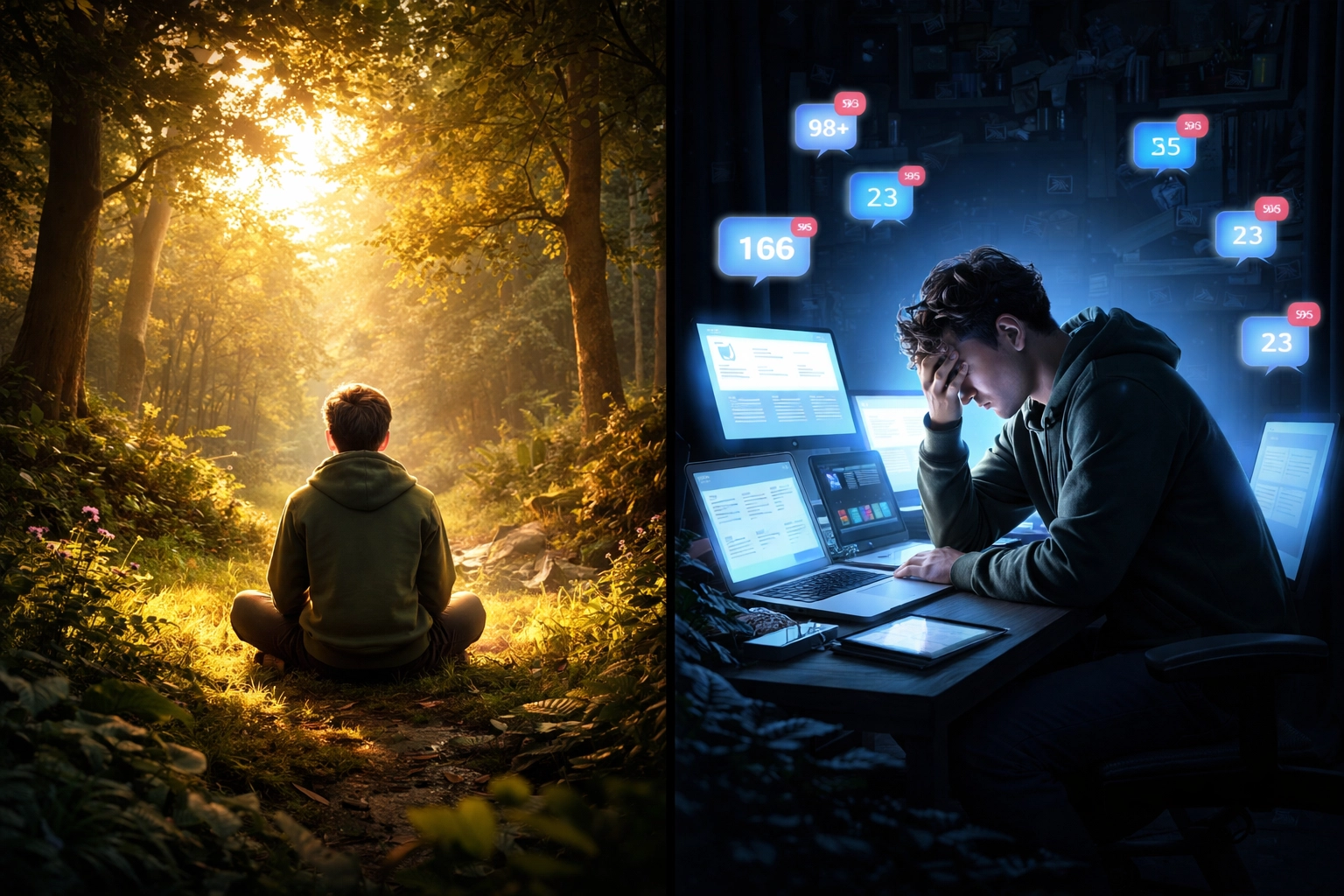
As I wrote in my New York Times opinion piece, we need to be honest about the harms that technology can cause, particularly for vulnerable populations (Ruttenberg, 2025b). The same systems that claim to connect us are often designed without any consideration for our neurological limits.
This is not sustainable. And it certainly is not human-centered.
A Different Approach: Neuroscience-Informed AI Design
So what would it look like to build AI systems that actually respect how our brains work?
Through my work developing multi-sensory assistive wearable technology, I have been exploring exactly this question (Ruttenberg, 2025c). The core principle is simple: technology should adapt to humans, not the other way around.
Here are the key design principles that emerge from neuroscience research:
1. Build in Cognitive Breaks
AI systems should recognize when users are approaching cognitive overload and actively encourage breaks. This could mean dimming interfaces, reducing notification frequency, or suggesting pause points. The goal is to protect directed attention rather than exploit it.
2. Reduce Sensory Clutter
Every visual element, sound, and animation on screen requires processing power from your brain. Human-centered AI should minimize unnecessary stimuli and present information in clean, digestible formats. Less is genuinely more when it comes to cognitive load.
3. Personalize Based on Individual Differences
Not everyone experiences digital environments the same way. People with sensory sensitivities, attention differences, or anxiety may reach overload much faster than others. AI systems should learn individual patterns and adjust accordingly.
My research on safeguarding autistic adults who use technology highlighted how critical personalization is for neurodivergent users (Ruttenberg, 2023). But honestly, these adaptations benefit everyone.
4. Prioritize Restoration, Not Just Engagement
What if AI systems measured success not by time-on-platform but by user wellbeing? This would require a fundamental shift in how we design and evaluate technology. But it is exactly the kind of shift we need.
The Path Forward
Digital fatigue is not inevitable. It is a design problem. And like all design problems, it has solutions.
The neuroscience is clear: our brains have limits, and we ignore them at our peril. But we also have unprecedented tools to build technology that respects those limits. AI can learn our patterns, anticipate our needs, and create environments that support rather than deplete us.
As I argued in The Miami Herald, we have to stop pretending that technology is neutral (Ruttenberg, 2025d). The choices we make in designing AI systems have real consequences for real people. It is time to make choices that prioritize human wellbeing.
This is not just a nice idea. It is an ethical imperative.
If you are building AI systems, ask yourself: does this design respect the neurological limits of the people who will use it? If you are using AI systems, advocate for designs that protect your cognitive health. And if you are making policy around technology, consider how neuroscience should inform the standards we set.
We can do better. Our brains are counting on it.
Dr David Ruttenberg PhD, FRSA, FIoHE, AFHEA, HSRF is a neuroscientist, autism advocate, Fulbright Specialist Awardee, and Senior Research Fellow dedicated to advancing ethical artificial intelligence, neurodiversity accommodation, and transparent science communication. With a background spanning music production to cutting-edge wearable technology, Dr Ruttenberg combines science and compassion to empower individuals and communities to thrive. Inspired daily by their brilliant autistic daughter and family, Dr Ruttenberg strives to break barriers and foster a more inclusive, understanding world.
References
Kaplan, S. (1995). The restorative benefits of nature: Toward an integrative framework. Journal of Environmental Psychology, 15(3), 169-182.
Ruttenberg, D. (2025a). Towards technologically enhanced mitigation of autistic adults’ sensory sensitivity experiences and attentional, and mental wellbeing disturbances [Doctoral thesis, University College London]. https://discovery.ucl.ac.uk/id/eprint/10210135/https://doi.org/10.13140/RG.2.2.16142.27201
Ruttenberg, D. (2025b, April 24). Opinion: Kennedy’s dangerous autism claims. The New York Times. https://www.nytimes.com/2025/04/24/opinion/kennedy-autism.html
Ruttenberg, D. (2025c). Multi-sensory, assistive wearable technology, and method of providing sensory relief using same (U.S. Patent No. US-12,208,213 B2). U.S. Patent and Trademark Office.
Ruttenberg, D. (2025d, April 18). Opinion: RFK Jr.’s claims about autism being an “epidemic” are harmful. The Miami Herald. https://www.miamiherald.com/opinion/letters-to-the-editor/article304284081.html
Ruttenberg, D., Porayska-Pomsta, K., White, S., & Holmes, J. (2020, May 3). Sound impairment effect on cognitive skill performance. https://doi.org/10.31219/osf.io/fng7d
Ruttenberg, D. P. (2023, April 9). Safeguarding autistic adults who use technology. Local Government Association. https://doi.org./10.17605/OSF.IO/5PJRV


Comments