Sensory Sensitivity and AI: Designing for the Neurodivergent Brain

Imagine walking into a grocery store. The fluorescent lights hum and flicker overhead. A dozen conversations blend into a wall of noise. The air conditioning creates a constant low drone. For many people, this is just... Tuesday. But for neurodivergent individuals: especially autistic adults: this sensory cocktail can trigger overwhelming distress, cognitive fatigue, and a desperate need to escape.
This is the reality of sensory sensitivity. And it is one of the most underaddressed challenges in technology design today.
The good news? Artificial intelligence is finally catching up. Researchers and innovators are building systems that do not just acknowledge sensory differences: they actively adapt to them in real time.
And for me, this is not abstract. It is personal. I am writing as a parent first: a dad to our daughter, Phoebe (23; autistic, ADHD, epilepsy). Our family story includes diagnoses, therapies, ER visits, and two craniotomies. It also includes the everyday, easy-to-miss stuff: the light that feels like sandpaper, the sound that hits like a siren, the texture that turns “fine” into “nope” in a second.
Not because she is “too sensitive.” Not because we are “too soft.” But because her nervous system is doing its job differently: detecting, filtering, prioritizing. And when you see that clearly, you stop blaming the person and start redesigning the environment.
My wife of 31 years (Suzy Girard at https://tenderwildfires.substack.com/) and I have learned that “support” is not one thing; it is a thousand tiny choices: lights, sound, timing, transitions. Not fixing a child to fit the world, but shaping the world so the child can breathe.
Understanding Sensory Sensitivity
Sensory sensitivity is not about being “too sensitive” or needing to “toughen up.” It is a neurological reality, and it often shows up in three distinct sensory profiles.
HYPER (over-responsive): sensory input lands too hard, too fast. This is the classic “everything is too loud/too bright/too itchy” experience, where ordinary environments can become physically painful or cognitively draining (Ruttenberg, 2025a).
HYPO (under-responsive): sensory input may not register strongly enough. A person might miss cues other people notice quickly: body signals, sounds, light changes: and may look “unbothered” or “checked out” when they are actually under-alerted (Ruttenberg et al., 2023).
SENSORY SEEKING (The Under-Sensitive Child (Sensory Seekers)): a person actively looks for extra input: movement, pressure, rhythm, texture: because that input helps them feel regulated and present (Child Mind Institute, 2025). This is not the same thing as HYPO. HYPO describes detection/registration; seeking describes a drive for input and a set of self-regulation behaviors (Understood, 2019).
If you are a parent, you have probably seen how these can overlap across senses. A child can be HYPER to sound, HYPO to interoception, and still have strong sensory seeking needs for movement or deep pressure (Understood, 2019). In our house, we have lived the “why is this hard?” moments, and we have also lived the “oh, this explains everything” relief when the right sensory lens clicks into place.
In my doctoral research at University College London, I explored how sensory sensitivity experiences affect autistic adults’ attention, focus, and mental wellbeing (Ruttenberg, 2025a). The findings were clear: unmanaged sensory environments do not just cause discomfort: they can significantly impair cognitive performance and quality of life.
This is not a niche problem. According to the UK Parliamentary Office of Science and Technology, invisible disabilities: including sensory processing differences: affect millions of people across education and employment settings (Ruttenberg et al., 2023). Yet most of our built environments and digital tools are designed as if everyone experiences the world the same way.

The Problem With One-Size-Fits-All Design
Here is the thing about traditional technology design: it assumes a “typical” user. Screens default to bright settings. Notification sounds are loud and attention-grabbing. Interfaces are cluttered with moving elements and competing visual cues.
For neurotypical users, these might be minor annoyances. For neurodivergent users, they can be genuine barriers to access.
Earlier research I conducted with colleagues at UCL demonstrated that sound impairment and auditory distractions can directly affect cognitive skill performance (Ruttenberg et al., 2020a). In other words, the sensory environment is not separate from how well someone can think, learn, or work: it is deeply intertwined. When the world is too loud, too bright, too much: attention fractures, energy drains, coping costs climb (Ruttenberg, 2025a).
This is why “accessibility” cannot just mean adding captions or screen reader compatibility. True inclusive design means building systems that adapt to the user, not the other way around.
Enter AI: Personalized, Adaptive, Responsive
This is where artificial intelligence changes the game.
AI-powered systems can now tailor sensory experiences to individual profiles. Instead of forcing everyone into the same mold, these tools recognize that a child who is HYPER might need calming visuals and softer audio, while someone who is HYPO may need clearer cues and stronger signals, and a sensory seeker may benefit from safe, intentional “input on purpose” (Interactive Sensory Environments, 2024; Child Mind Institute, 2025).
Even more powerful: real-time detection and adjustment. Using integrated sensors and vision-based tracking, AI systems can detect signs of overstimulation, distraction, or fatigue and automatically adjust the environment (Interactive Sensory Environments, 2024). Imagine an app that dims your screen when it senses you are becoming overwhelmed, or a workspace that adjusts lighting based on your stress levels.
This is not science fiction. This is happening now.

Building Sensory-Aware Wearables
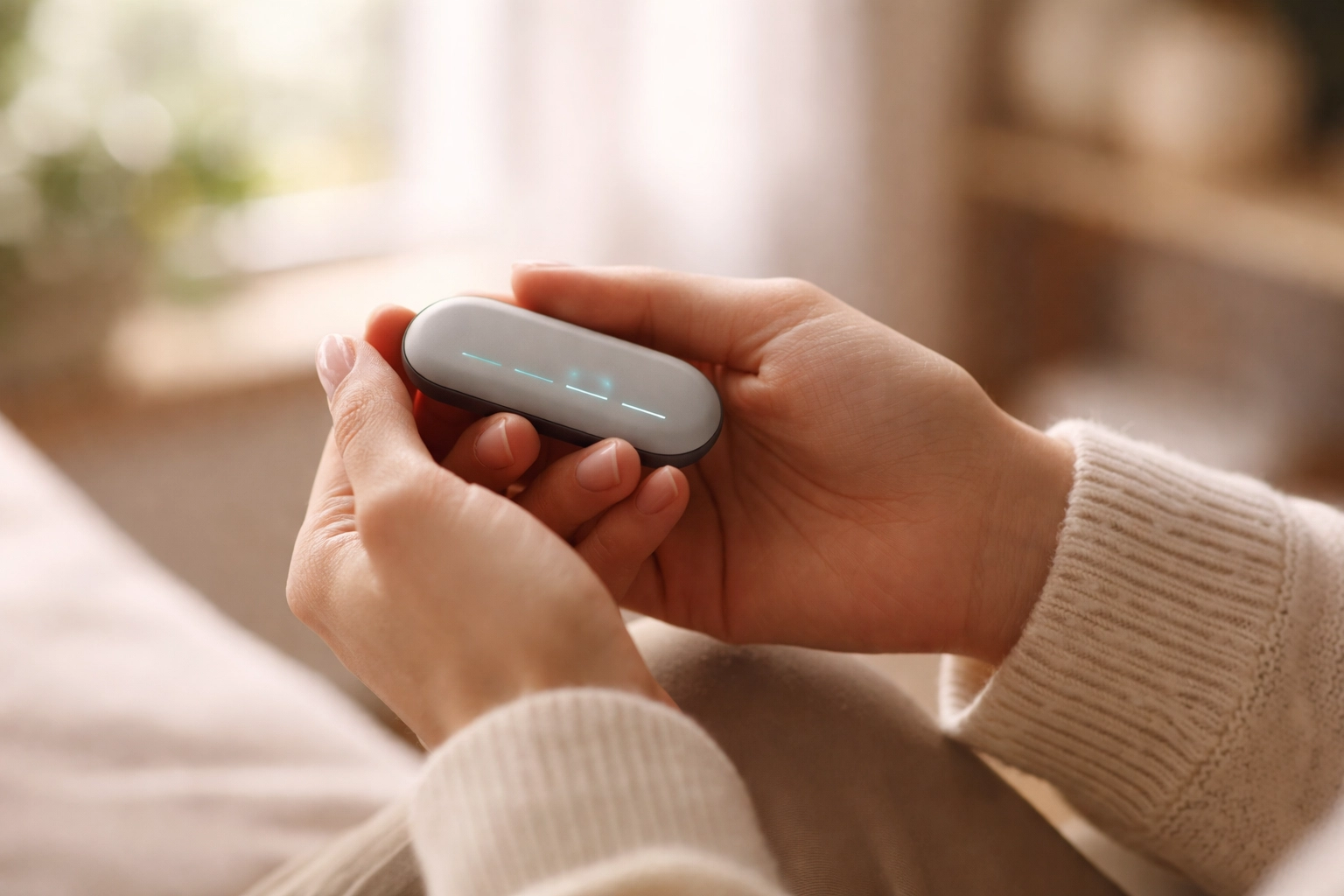
I have spent years working on this exact problem. My research led to the development of multi-sensory, assistive wearable technology designed to provide sensory relief for individuals with sensory processing differences.
This work resulted in multiple international patents, including U.S. Patent US-12,208,213 B2 (Ruttenberg, 2025b), with additional filings through the European Patent Office, World Intellectual Property Organization, Canadian Intellectual Property Office, and Japanese Patent Office.
The core idea is straightforward: give people tools that respond to their unique sensory needs. Not generic “wellness” gadgets, but purpose-built technology informed by neuroscience and designed with input from the communities it serves.
In my PPI (Patient and Public Involvement) research, I explored what autistic individuals actually want from adaptive wearable interventions (Ruttenberg et al., 2020b). Spoiler alert: they want control, transparency, and respect for their autonomy. They do not want to be “fixed”: they want to be supported.
The Ethics of Sensory AI
Of course, building AI that monitors and responds to sensory states raises important ethical questions.
Who owns the data? How do we prevent surveillance creep? What happens when these tools are used in workplaces or schools without consent?
I wrote about safeguarding autistic adults who use technology for the Local Government Association (Ruttenberg, 2023). The bottom line: ethical AI must prioritize user agency. People should be able to control what data is collected, how it is used, and when the system intervenes.
Brain-inspired AI that processes multiple sensory inputs together: mimicking how biological brains naturally integrate vision, hearing, and touch: offers a promising path forward (Brain-Inspired Computing Research, 2024). But the technology is only as ethical as the people building and deploying it.
What Comes Next
The future of sensory-aware AI is bright, but it requires intentionality. Designers, engineers, and policymakers need to:
Include neurodivergent voices in every stage of development
Prioritize transparency about how AI systems make decisions
Build for flexibility, recognizing that sensory needs change over time and context
Resist the urge to over-monitor, balancing helpfulness with respect for privacy
We have the tools. We have the science. Now we need the commitment to build technology that truly works for everyone.
Join the Conversation
If you are interested in sensory-inclusive design, ethical AI, or neurodiversity advocacy, I would love to hear from you. Visit davidruttenberg.com to learn more about my research and connect.
Together, we can build a world where technology adapts to people: not the other way around. If you are a parent, educator, or leader trying to make sensory support real (not theoretical), reach out through the site and tell me what environment you are trying to improve: home, classroom, clinic, workplace. We will make it practical, measurable, humane.
Dr David Ruttenberg PhD, FRSA, FIoHE, AFHEA, HSRF is a neuroscientist, autism advocate, Fulbright Specialist Awardee, and Senior Research Fellow dedicated to advancing ethical artificial intelligence, neurodiversity accommodation, and transparent science communication. With a background spanning music production to cutting-edge wearable technology, Dr Ruttenberg combines science and compassion to empower individuals and communities to thrive. Inspired daily by their brilliant autistic daughter and family, Dr Ruttenberg strives to break barriers and foster a more inclusive, understanding world.
References
Child Mind Institute. (2025, February 13). Quick guide to sensory processing issues. https://childmind.org/guide/quick-guide-to-sensory-processing-issues/
Interactive Sensory Environments. (2024). AI-powered sensory adaptation for neurodivergent individuals. Sensory Technology Research Review.
Brain-Inspired Computing Research. (2024). Multi-sensory integration in artificial intelligence systems. Journal of Neuromorphic Engineering.
Understood. (2019, August 5). Understanding sensory processing challenges in your child. https://www.understood.org/en/articles/understanding-sensory-processing-challenges
Ruttenberg, D. (2023, April 9). Safeguarding autistic adults who use technology. Local Government Association. https://doi.org/10.17605/OSF.IO/5PJRV
Ruttenberg, D. (2025a). Towards technologically enhanced mitigation of autistic adults’ sensory sensitivity experiences and attentional, and mental wellbeing disturbances [Doctoral dissertation, University College London]. https://discovery.ucl.ac.uk/id/eprint/10210135/
Ruttenberg, D. (2025b). Multi-sensory, assistive wearable technology, and method of providing sensory relief using same (U.S. Patent No. US-12,208,213 B2). U.S. Patent and Trademark Office.
Ruttenberg, D., Porayska-Pomsta, K., White, S., & Holmes, J. (2020a, May 3). Sound impairment effect on cognitive skill performance. https://doi.org/10.31219/osf.io/fng7d
Ruttenberg, D., Porayska-Pomsta, K., White, S., & Holmes, J. (2020b, May 3). PPI questionnaire on adaptive wearable appropriateness as an autistic intervention. https://doi.org/10.31219/osf.io/a3jbz
Ruttenberg, D., Rivas, C., Kuha, A., Moore, A., & Sotire, T. (2023, January 12). Invisible disabilities in education and employment. United Kingdom Parliamentary Office of Science and Technology POSTnote, (689), 1-23.


Comments